
Line 6 Spider V 20 MKII
4.5Editor score
Sixteen amp and effects presets
Three simultaneous effects
Integrated tuner and tap tempo
Remote app editing and recording
A 20W guitar amp is a versatile choice for bedroom practice, lessons, small rehearsals, and modest performances where portability matters more than stadium-level volume. The best models balance useful tone controls, clean and overdrive channels, speaker clarity, practical connections, and a cabinet that is easy to move without feeling flimsy.
This guide compares ten 20-watt amplifiers using their supplied specifications, customer ratings, control layouts, speaker configurations, and connectivity. It covers traditional analog combos, portable practice amps, Bluetooth-equipped units, and digital modeling options, helping readers identify the model that best matches their playing style, environment, and need for effects.
Each selection highlights a distinct approach, from straightforward beginner-friendly combos to feature-rich amps with wireless playback, built-in effects, dual inputs, and app-based editing. Ratings and product details reflect the information available in October 2026, while prices and availability can change, so readers should verify current listings before purchasing.
4.5Editor score
4.6Editor score

4.4Editor score
As an Amazon Associate we earn from qualifying purchases.
The table below compares all ten amplifiers by power, speaker, channel design, and practical connectivity, making it easier to distinguish simple practice combos from more versatile performance and modeling options.


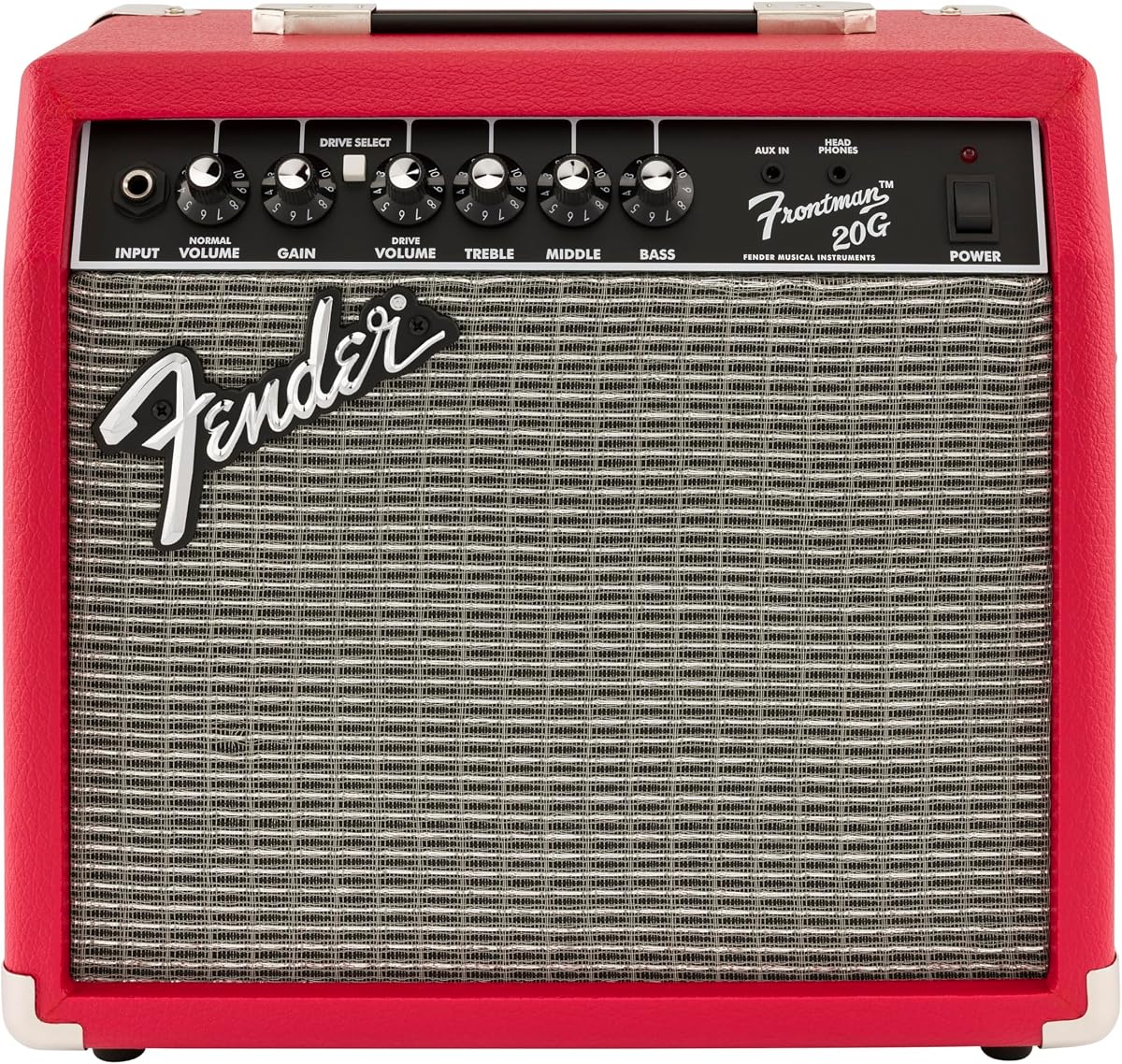
The Fender Frontman 20G combines a 20-watt output, an eight-inch Fender Special Design speaker, and a straightforward control panel in a format suited to both beginners and experienced players. Its supplied rating is 4.6, placing it among the strongest-reviewed models in this guide. The appeal comes less from feature count than from the familiar combination of a dedicated clean channel, a switchable drive channel, and separate volume controls.
We may earn a commission when you buy through this link, at no additional cost to you.
The clean channel provides volume and three EQ knobs for treble, mid, and bass, allowing meaningful tonal shaping without navigating a dense signal chain. The drive channel has its own volume, so a player can move between clearer and more aggressive sounds without repeatedly redialing the same settings. An auxiliary input supports playing along with external music, while the headphone jack provides a private option for late practice.
The main limitation is that the Frontman 20G does not include built-in reverb, delay, modulation, or a digital modeling system. Players who want those sounds will need a pedal, processor, or another amplifier. Its single input also means it is less accommodating than the Rockville G-AMP 20 for spontaneous two-guitar sessions. These are not universal drawbacks, though, because the simple channel-and-EQ layout is exactly what many players want from a compact practice combo.
This is the strongest general recommendation for someone seeking a recognizable 20W guitar amp that is easy to understand, versatile enough for practice and small performances, and backed by a two-year limited warranty. It is particularly well suited to players who want direct analog controls rather than menus or app-based editing. New guitarists can start with the clean channel, then add the drive channel as their playing develops.
Separate clean and drive channels make it easy to compare tonal approaches without resetting the amplifier. The three-band EQ on the clean channel also provides enough range for common adjustments without turning a routine practice session into a technical exercise.
The auxiliary input is useful for practicing with songs, lessons, or backing tracks, while the headphone output allows quieter practice. These connections make the amp adaptable to bedrooms, shared rooms, and focused study sessions.
We may earn a commission when you buy through this link, at no additional cost to you.
The Rockville G-AMP 20 stands out with a 6.5-inch speaker, 20 watts of power, Bluetooth connectivity, two guitar inputs, and a built-in delay effect. Its supplied rating is 4.5. The combination is especially useful for practice sessions because it can receive music wirelessly from a phone and still provide conventional guitar and headphone connections.
We may earn a commission when you buy through this link, at no additional cost to you.
Its Clean/Overdrive channels and three-band EQ offer a familiar starting point for players who want simple tonal control. The built-in delay adds ambient depth without requiring a separate pedal, and the LED status light gives visual feedback during operation. For lessons or informal jam sessions, the dual guitar inputs are a meaningful convenience because two instruments can be connected at once.
The primary compromise is that Bluetooth is described as a method for streaming backing tracks or play-along music, not as a wireless control system. Players who expect to switch presets, adjust the amp remotely, or use it as an interface will need to look elsewhere. The 6.5-inch speaker is also smaller than the 8-inch drivers found in several traditional combos, which may influence low-end response and maximum usefulness in a noisy rehearsal room.
The G-AMP 20 is a strong choice for guitarists who want wireless music, two-player capability, and one practical onboard effect in a portable package. It works particularly well for lessons, bedroom practice, and small gatherings where two guitars might be used. For recording, mobile control, or a broad library of modeled tones, one of the digital or recording-oriented alternatives may be a better fit.
Streaming backing tracks wirelessly keeps phones and media players away from the amp. It is a simple convenience that can make practice setups cleaner and reduce the need for a dedicated auxiliary cable.
The dual guitar inputs make this amp useful for lessons, duet practice, or a casual jam. The feature is uncommon in compact models and adds flexibility without changing the amp's basic 20-watt class.
We may earn a commission when you buy through this link, at no additional cost to you.
The Leo Jaymz 20W Electric Guitar Amplifier offers a useful combination of clean and distortion channels, three-band equalization, a 6.5-inch speaker, and both CD line and auxiliary inputs. Its supplied customer rating is 4.4. This makes it a budget-oriented option for players who want more tone control than a bare-bones practice amp without moving into a digital modeling platform.
We may earn a commission when you buy through this link, at no additional cost to you.
The distinction between clean and distortion channels gives beginners an easy way to explore tonal contrast. Bass, mid, and treble controls provide the expected means to shape the sound, and the line input offers a convenient way to play along with recorded material. A leather surface and comfortable handle are also described, which supports the amp's intended use in a practice room, small courtyard, or home setting.
Compared with feature-rich digital amps, the Leo Jaymz is limited. It does not list a built-in tuner, effects suite, Bluetooth, app editing, headphone connection, or recording output in the supplied information. There is also only one guitar input, so it is not designed for immediate two-guitar lessons. Its input voltage is listed as 110–130V at 50/60Hz, making compatibility with local power standards worth checking before use.
This model is best for a budget-conscious player who wants dedicated clean and distortion channels plus a three-band EQ. It may be especially useful for students who need an amp for a bedroom, lesson room, or occasional small gathering and do not require wireless connectivity or computer integration. Among straightforward combos in this category, its control set is notably accommodating for the segment.
Clean and distortion channels offer a clear way to compare two common guitar sounds. A beginner can move between them without navigating a dense effects interface, while the three-band EQ makes basic adjustments more intuitive.
The CD line and auxiliary inputs support practice with recorded tracks. These options are useful for learning arrangements, rehearsing songs, and building confidence without requiring a wireless-enabled amp.
We may earn a commission when you buy through this link, at no additional cost to you.
The Orange Crush 20 combines a 20-watt output, an eight-inch speaker, a twin-channel layout, a high-gain preamp, and a three-band EQ. Its supplied rating of 4.7 is the highest among the ten products featured. It appeals to players who want an assertive, traditional combo amplifier with a more substantial speaker than the smaller portable units in the list.
We may earn a commission when you buy through this link, at no additional cost to you.
The two channels give users access to clean and driven sounds, and the high-gain preamp is designed for players who want to push the amp harder. The three-band EQ provides broad tonal adjustment, while the auxiliary input and cabsim-loaded headphone output serve both backing-track playback and private practice. The cabsim feature is particularly relevant for headphone users because it offers a speaker-oriented signal treatment rather than a raw, unprocessed output.
As an analog-style combo, it does not offer Bluetooth, a multi-effects suite, app control, computer recording, or a long list of amp models. Those omissions are reasonable if the goal is straightforward guitar amplification, but they may limit the amp for players who want to experiment digitally. The 20-watt power level also means it remains primarily suited to practice, lessons, and small rooms rather than large stages.
The Orange Crush 20 is a compelling premium choice for players who value a classic combo format, a larger speaker, and a strong gain channel. It is well suited to rock-leaning players who want meaningful tonal control without digital menus. Those seeking wireless music or extensive effects should consider the Rockville or Line 6, respectively, while the Orange remains a focused, traditional guitar amp.
The eight-inch speaker gives this combo a different character from the 6.5-inch practice models. It is still a compact 20-watt amp, but the larger driver can provide a more assertive presentation in practice and rehearsal settings.
The twin-channel arrangement and high-gain preamp make the Crush 20 appealing to players who want to move between clean and aggressive sounds. The absence of a large effects menu keeps the signal path approachable.
We may earn a commission when you buy through this link, at no additional cost to you.
The Frontman 20G Bundle packages a 20-watt Fender combo with an 8-inch Fender Special Design speaker, an instrument cable, and a 12-pack of Austin Bazaar picks. Its supplied rating is 4.6. For a first-time guitarist, the appeal is immediacy: the essentials needed to connect a guitar and begin playing are included in one package.
We may earn a commission when you buy through this link, at no additional cost to you.
Tonal controls cover gain, volume, treble, and bass, while an overdrive switch provides access to distorted sounds. The auxiliary input and headphone output support both playing along with external music and quieter practice. This is a conventional, easy-to-learn layout, so it avoids the steep learning curve associated with digital modeling systems.
The main purchasing consideration is whether the included accessories fill a genuine need. A player who already owns an instrument cable and plenty of picks may see the bundle as less valuable than the core amp alone, although the current listing combines both components as a set. The amplifier also has no built-in effects beyond overdrive, no wireless functionality, and only one input, limiting options for advanced signal routing and two-player sessions.
This bundle is best for a new guitarist who wants a complete, uncomplicated starting setup. It is also a logical choice for a student who needs a dependable practice amp, a cable, and picks without assembling each purchase separately. Players who already have their accessories or want effects, recording, and app control should compare the standalone Frontman 20G and the Line 6 Spider V 20 MKII.
Including a cable and a generous pack of picks removes two common early purchases. The arrangement is particularly convenient for a new player who wants to move from unboxing to playing with minimal setup.
Gain, volume, treble, bass, and overdrive cover the essential beginner controls. Players can learn how each adjustment affects the sound without navigating complex menus or digital presets.
We may earn a commission when you buy through this link, at no additional cost to you.
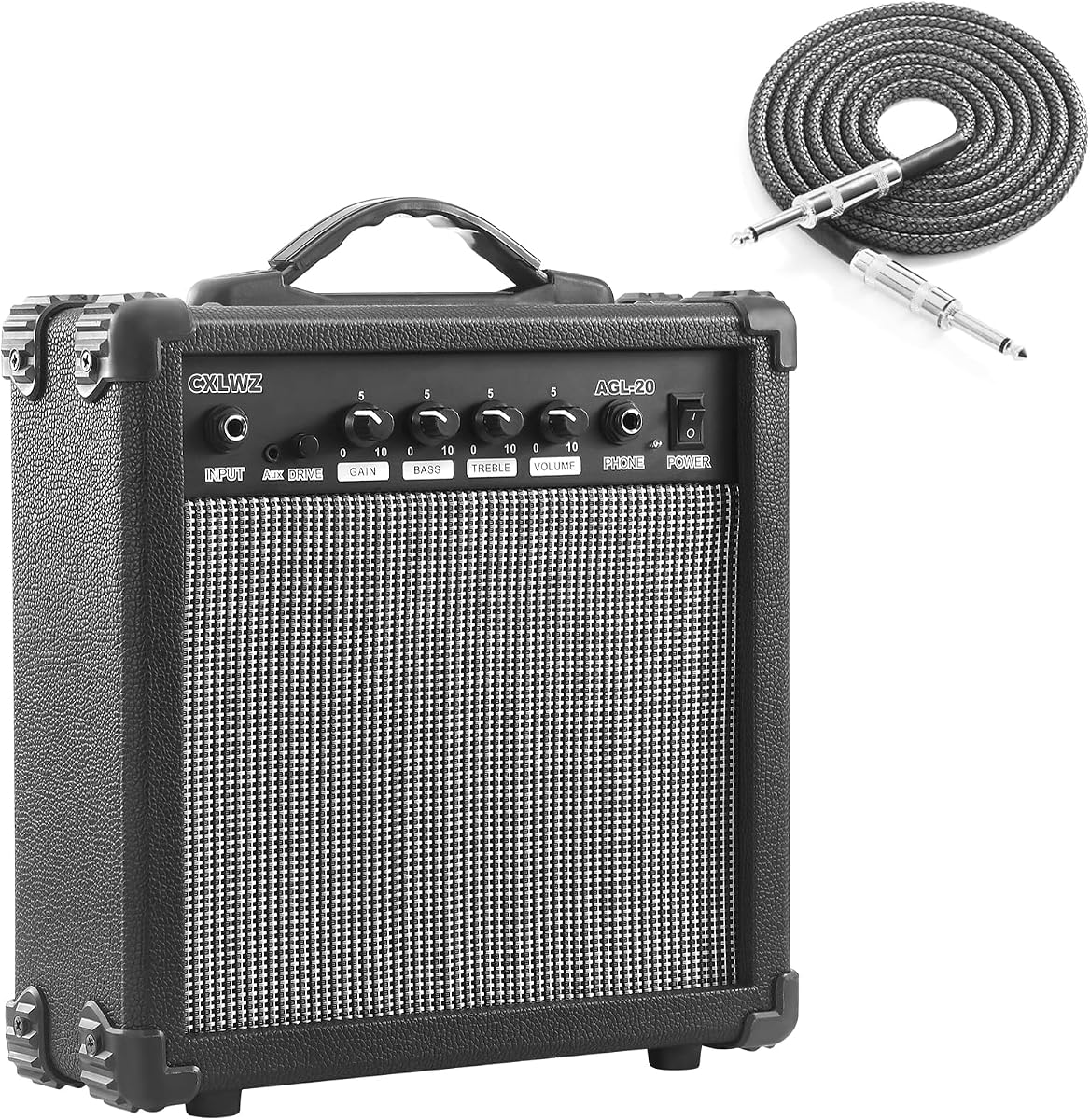
This 20-watt portable electric guitar amplifier weighs just 6.2 pounds and is designed for moving between a bedroom, garage, car, rehearsal, or gig. Its supplied rating is 4.4. Rather than competing through a long digital feature list, the amp focuses on portability, basic tone controls, connectivity, and physical protection.
We may earn a commission when you buy through this link, at no additional cost to you.
Gain, bass, treble, and volume controls cover the main adjustments needed to move from clean sounds to distortion. An auxiliary input accepts music from a phone or MP3 player, and a headphone jack allows quiet practice. The included professional-quality noise-shielded 6.35mm cable is intended to maintain stable audio while reducing unwanted background interference.
The cabinet includes thickened edges, rigid edge binding, and wide rubber base pads intended to protect against drops and vibration. Those details are reassuring for travel and busking, although the product listing does not identify the speaker diameter or give a full technical breakdown of the amplifier's output. Buyers who need exact speaker dimensions, frequency response, or recording specifications should consider a model with more fully published specifications.
The product is best for players who regularly carry an amp and need the lightest practical option in this guide. It suits home practice, mobile rehearsals, small performances, and situations where setup time and portability matter. Guitarists seeking a more established brand identity, larger speaker, digital effects, or advanced connectivity may prefer one of the Fender, Orange, or Line 6 options.
At 6.2 pounds, the amplifier is easy to move between rooms or transport in a vehicle. Reinforced edges and rubber base pads help the cabinet remain stable while protecting vulnerable contact points.
The supplied shielded 6.35mm cable is designed for stable signal transfer with less background noise. It can be particularly useful for users who want a ready-made connection rather than a separate accessory purchase.
We may earn a commission when you buy through this link, at no additional cost to you.
The 20W Beginner Practice Amp is a compact 6.5-inch combo designed for lessons, bedroom practice, jam sessions, and travel. It carries a supplied rating of 4.2, the lowest in this roundup, though it also includes several accessories that can make it convenient for a first setup. The supplied information lists gain, bass, treble, and volume controls, a built-in drive, a guitar input, an auxiliary jack, and a headphone jack.
We may earn a commission when you buy through this link, at no additional cost to you.
The included accessory set is unusually extensive for a compact amp. It includes a three-meter noiseless cable, a 6.5mm-to-3.5mm headphone adapter, guitar picks, an auxiliary cable, and earphones. For a new player, that can provide a quick path from setup to playing, especially if none of these common accessories are already owned.
The lower supplied rating warrants a measured approach, although ratings alone do not reveal the reasons for individual experiences. The product description does not provide detailed specifications for the preamp, speaker output beyond its size, construction materials, or warranty. It also lacks Bluetooth, digital effects, a recording output, and a tuner, so it is best viewed as a straightforward practice amp rather than a platform for advanced experimentation.
This amp is most suitable for a beginner who values portability and included accessories over extensive onboard effects. The drive circuit provides a useful second tonal option, and the headphone and auxiliary connections support different practice styles. Players seeking a well-known brand, detailed product documentation, a larger speaker, or advanced connectivity should favor a more established model in the comparison.
The cable, adapter, picks, auxiliary lead, and earphones cover several common beginner needs. This makes the package attractive for someone who wants to begin playing without searching for separate accessories first.
Gain, bass, treble, and volume cover the most common adjustments, while the drive circuit adds a gritty alternative. The layout keeps the amp approachable for lessons and everyday practice.
We may earn a commission when you buy through this link, at no additional cost to you.
The Fender Champion II 25 is included because it sits close to the 20-watt class while offering a broader range of effects and recording-related connections. It produces 25 watts through an 8-inch Fender Special Design guitar speaker and has a supplied rating of 4.6. Its main appeal is the built-in multi-effects suite, which includes reverb, delay and echo, chorus, tremolo, Vibratone, and additional effects.
We may earn a commission when you buy through this link, at no additional cost to you.
A tap button makes it possible to set delay times and tremolo speeds to match a song's tempo. This is a valuable feature for guitarists who want synchronized ambience or modulation without carrying a separate pedal. The rear-panel USB port, auxiliary input, and headphone output add practical options for external media, private practice, and computer-oriented use.
The Champion II is not a strict 20-watt model, so shoppers focused specifically on the stated 20W keyword should understand that distinction. It also uses a single-channel design, so it does not offer the convenient clean and drive switching found in the Frontman 20G, Orange Crush 20, and Rockville G-AMP 20. Its effect menus also introduce more complexity than the straightforward control layouts of simpler practice combos.
This amp is a strong option for a player who wants traditional Fender speaker character with convenient onboard effects and USB capability. It is well suited to bedroom practice, lessons, rehearsals, and small gigs where a polished tone without a pedal board is desirable. Among the list, it bridges familiar combo construction and modern convenience particularly effectively.
Reverb, delay, chorus, tremolo, and other effects provide a broad palette directly in the amplifier. This reduces setup time and gives new players several familiar ways to shape a basic tone.
The tap function helps align repeating effects and speed-based modulation with a performance. Players can set tempos by tapping rather than estimating values from a menu, making synchronized effects more approachable.
We may earn a commission when you buy through this link, at no additional cost to you.
The Line 6 Spider V 20 MKII is the most digitally focused amplifier in the guide. It provides 16 presets, allows three effects to operate simultaneously, includes independent reverb, and adds a built-in tuner and tap-tempo function. Its supplied rating is 4.5. For players who want to explore many amplifier and effect styles, this 20-watt model offers considerably more variety than a conventional analog combo.
We may earn a commission when you buy through this link, at no additional cost to you.
A free remote app expands access to more than 200 amp and effects options. The supplied information also states that users can edit and record on Mac, PC, iOS, and Android devices. That cross-platform support makes the Spider V useful for a player who wants to capture ideas, organize sounds, or practice with a connected device rather than adjusting every parameter directly on the cabinet.
The tradeoff is complexity. A new guitarist who simply wants a volume knob, three-band EQ, and overdrive switch may find the digital control system more than necessary. Full remote and recording functions also depend on a compatible device and the appropriate software connection. Players who want an easy-to-grab analog amp will likely find the Frontman 20G, Leo Jaymz, or Orange Crush 20 more approachable.
The Spider V 20 MKII is the top choice for technology-minded players who want a broad range of sounds and app-based flexibility in a compact format. It is especially appealing to guitarists interested in home recording, preset experimentation, and having many amplifier references available without maintaining a large physical pedal collection.
Sixteen onboard presets and more than 200 available amps and effects give players a large range of starting points. The classic speaker mode adds another tonal option within an already broad selection.
Editing and recording support for Mac, PC, iOS, and Android broadens the amp's role beyond a standalone practice speaker. A guitarist can capture ideas and refine settings without treating the amplifier as a closed system.
We may earn a commission when you buy through this link, at no additional cost to you.
The Monoprice 1×8 Guitar Combo is a 20-watt amplifier with an 8-inch, 4-ohm speaker, a 1/4-inch guitar input, an auxiliary input, a headphone output, and a line-level output. Its supplied rating is 4.5. The defining feature is the line-level output, which can send the amp signal to a recorder or mixing board and makes this model more versatile for home recording than many basic practice combos.
We may earn a commission when you buy through this link, at no additional cost to you.
The overdrive circuit is described as providing 86dB of gain, giving players access to a high-gain range without requiring a separate distortion pedal. The larger 8-inch speaker can support a fuller response than smaller practice speakers, while the auxiliary MP3 input allows players to perform along with existing songs. A 3.5mm headphone output supports quieter practice.
It is important to distinguish a line-level output from a full computer audio interface. The supplied information confirms that the signal can be routed to a recorder or mixing board, but it does not state that the amp functions as a plug-and-play USB audio interface. Users wanting direct computer recording, app control, or a large effects ecosystem may prefer the Line 6 Spider V 20 MKII.
The Monoprice 1×8 is a strong recommendation for players who want basic overdrive, a practical 20-watt combo, and an easy path into recording through existing hardware. It works well for bedroom sessions, project recording, and small rehearsals. It is less suitable for anyone seeking Bluetooth music, multiple inputs, or a deep library of onboard digital effects.
The line-level output lets the amp feed an existing recorder or mixer. This is a meaningful advantage for home players who want to capture their guitar without depending entirely on computer software or additional modeling hardware.
The stated 86dB gain specification supports access to overdriven and highly amplified sounds. Combined with the 8-inch speaker, it gives the combo a more performance-oriented character than a minimal practice amp.
We may earn a commission when you buy through this link, at no additional cost to you.
A useful 20W guitar amp should fit the player's space, sound, and practice routine. Compare speaker size, control complexity, available connections, portability, and recording features rather than focusing only on wattage.
A 20-watt amp is generally most useful in a bedroom, home office, lesson room, garage, or compact rehearsal space. It can provide enough power for practice and small gatherings, but it is not designed to fill a large hall. Think about how much background noise the amplifier needs to project over and how much room you have available. A larger 8-inch speaker may offer more presence than a 6.5-inch model, while a lightweight cabinet can be easier to reposition when floorspace is limited. Players who regularly perform outdoors or in noisy rooms may eventually want more output than this category provides, but 20 watts remains an effective training and home-practice level.
The speaker is one of the most important components shaping an amplifier's character. In this guide, several portable combos use a 6.5-inch speaker, while the Orange Crush 20, Fender Frontman 20G, Fender Champion II, and Monoprice 1×8 use 8-inch drivers. A larger speaker can provide a fuller low-end response and greater projection, but it also adds cabinet size and may make the amp less convenient to carry. Smaller speakers are common in lightweight practice amps and work well when the goal is clear, focused tone in a bedroom. There is no universally correct size, so consider both the room and the player's need for portability.
A two-channel design is often the simplest way to move between clean and distorted sounds. The Frontman 20G, Orange Crush 20, Rockville G-AMP 20, and Leo Jaymz amp all provide separate channels or clearly defined clean and overdrive options. A three-band EQ with bass, middle, and treble controls is the standard tonal vocabulary for analog-style practice amps. Digital platforms add presets, modeled amp characters, and deeper effect menus, which can be exciting for experienced players but may create a steeper learning curve. Beginners should prioritize an intuitive layout, while players who already know what sounds they want may appreciate a broad range of selectable voices.
Consider every device the amplifier must support. A headphone output enables quiet practice, an auxiliary input allows playback of songs or backing tracks, and Bluetooth removes the need for a media cable. Some models provide two guitar inputs for lessons or duo jams, while the Monoprice 1×8 includes a line-level output for a recorder or mixer. The Fender Champion II adds USB, and the Line 6 supports app editing and recording on major computer and mobile platforms. More connections are not automatically better, but the right set can make an amp much more convenient for a particular routine. Check the exact jack sizes and confirm that any included adapters fit your instrument and headphones.
A 20W amp is often chosen because it can be moved more easily than a larger amplifier, but weight and construction still vary. The 20W Portable Guitar Amplifier is listed at 6.2 pounds, while other products rely on carry handles, corner protectors, rubber feet, leather coverings, or a larger cabinet. Look for details that match your transport situation. A handle is useful for moving between rooms, while a broad rubber base can improve stability. Protective corner pieces and reinforced edges are useful for frequent gigging or busking. If the amplifier will live in one room, build quality and speaker character may matter more than minimizing every gram.
Effects can add range without filling a pedalboard, but they also create more controls to learn. The Fender Champion II includes reverb, delay, chorus, tremolo, Vibratone, and other effects, with tap control for matching song tempo. The Line 6 Spider V 20 MKII provides 16 presets, three simultaneous effects, independent reverb, a tuner, tap tempo, and a large app-based library. The Rockville includes a basic built-in delay, while several analog options limit distortion to an overdrive channel. A player who wants a broad sonic palette should compare effect depth, while someone focused on clean guitar fundamentals may prefer fewer options and faster access to volume and EQ.
Recording needs can determine which connections matter most. A line-level output can send the Monoprice 1×8 to an existing recorder or mixing board, while the Line 6 offers editing and recording through compatible computers and mobile devices. Neither feature should be assumed to provide the exact workflow of a dedicated audio interface without checking the supplied connection details. If your primary aim is simply to play along with existing music, look for an auxiliary input or Bluetooth playback. If your aim is to capture ideas, prioritize a line-level output, USB support, or documented compatibility with recording software over a larger number of general-purpose features.
A complete package can be more useful than the lowest standalone cost, especially for a new guitarist. The Frontman 20G Bundle includes a cable and 12 picks, while the 20W Beginner Practice Amp includes a noiseless cable, headphone adapter, picks, auxiliary cable, and earphones. These extras are useful when starting from nothing, but they add little for someone who already owns reliable cables and picks. Compare the included accessories with what you actually need, and also consider warranty coverage. The Fender Frontman 20G and Champion II each include a two-year limited warranty, which can be reassuring for long-term ownership.
Place the amplifier on a stable, level surface with the rear ventilation area unobstructed. Leave enough room around the cabinet for sound to move, connect the guitar cable before powering up, and set the volume low when switching on. Many analog amps respond best when the volume and gain controls begin at their lowest positions. For a clean starting point, select the clean channel, set the EQ near its center positions, and raise the volume gradually before adding gain. Use the headphone output for low-volume practice and the auxiliary input for backing tracks, keeping external playback levels low enough to preserve headroom.
Turn the amplifier off before changing connections or moving it, and do not leave it operating unattended. Use the manufacturer-recommended power connection for the region where it will be used, particularly when voltage specifications are listed. Clean the cabinet and control panel with a soft, slightly damp cloth, but keep liquid away from ventilation openings, jacks, knobs, and the speaker grille. Do not use abrasive household cleaners. For digital models, update the companion app and firmware when available, and store custom presets in both the amp and the app so a reset does not remove a carefully configured sound.
For long-term storage, disconnect the power cable and keep the amplifier in a dry, ventilated location away from direct sunlight and moisture. Inspect cables for damaged plugs or intermittent connections, and avoid hanging heavy objects from the carry handle. To clean a tube-equipped or vintage-style unit, follow its service instructions rather than opening the cabinet yourself. Solid-state practice amps still contain high voltage during operation and should not be opened without appropriate technical knowledge. If the sound becomes distorted at low settings, a channel stops responding, or a jack becomes intermittent, stop using the amplifier and have the unit inspected.
A 20W guitar amp is generally well suited to bedroom practice, lessons, and small rehearsals. It can provide a clearly audible tone without the bulk of a larger amplifier. In a noisy room or a large performance space, however, a higher-output model may project more effectively. Players who practice at moderate volume and occasionally perform in small venues will get the most useful balance from this category.
A 6.5-inch speaker is common in compact practice amps and can make the cabinet easier to carry. An 8-inch speaker generally provides a fuller low-end response and more presence, though it usually requires a larger enclosure. The best choice depends on portability versus tone and projection rather than the speaker measurement alone.
Many 20W combos include a headphone output, including the Fender Frontman 20G, Orange Crush 20, Rockville G-AMP 20, Monoprice 1×8, Champion II, and several portable models. Headphones make late-night practice quieter and can be more comfortable than a low-volume speaker. Check the plug size and whether the amp provides a speaker-simulation treatment, particularly if using high-gain settings.
It depends on playing style and experience. Built-in reverb, delay, chorus, and tremolo can make an amp more versatile without a pedalboard, while simple clean and overdrive channels are enough for many beginners. Players who already own effects pedals may prefer a straightforward analog control panel. Those interested in recording and preset editing will find the Line 6 Spider V 20 MKII particularly relevant.
It depends on the model and the type of connection. The Fender Champion II includes a rear-panel USB port, and the Line 6 Spider V 20 MKII supports editing and recording on Mac, PC, iOS, and Android devices. The Monoprice 1×8 offers a line-level output for a recorder or mixer. Check current documentation for exact interface requirements rather than assuming every USB connection provides plug-and-play audio.
Most guitar amplifiers in this category use a standard 1/4-inch instrument input, so a regular guitar cable with 1/4-inch plugs is the normal requirement. Some bundled accessories use 6.35mm or 3.5mm connectors for headphones or auxiliary signals, so adapters may be included. Always confirm the amp's input type and avoid confusing a headphone or aux plug with a guitar connection.
Yes, because 20W amps are commonly used for learning, bedroom practice, and small-room rehearsals. The Frontman 20G, Leo Jaymz 20W, and 20W Beginner Practice Amp offer approachable layouts with basic tone controls. A beginner should choose a model with intuitive channels and EQ controls, while avoiding one that offers complexity the player does not yet need.
Most models provide an auxiliary input for a phone, MP3 player, or other audio source. The Rockville G-AMP 20 also supports Bluetooth playback, which can reduce cable clutter. Set the external source volume relatively low and raise the amp volume afterward to minimize distortion and preserve a clean signal for the guitar.
The Fender Frontman 20G is the strongest all-around recommendation because it combines a clear clean channel, a separate drive channel, a three-band EQ, auxiliary and headphone connections, and a straightforward control layout. The Line 6 Spider V 20 MKII takes the premium digital route with 16 presets, extensive app-based sounds, recording support, a tuner, and tap tempo. For budget-conscious players, the Leo Jaymz 20W provides clean and distortion channels, three-band equalization, and useful line and auxiliary inputs at an accessible entry point.
Prioritize the features you will actually use. A beginner may value intuitive controls and a lightweight cabinet, while a gigging guitarist may look for an 8-inch speaker, stronger gain character, or durable construction. Lesson instructors might prioritize dual guitar inputs, home recordists may want line-level or USB output, and bedroom players may care most about headphone support. Bluetooth is convenient for backing tracks, but it should not replace a clear sound and control workflow in your decision.
Finally, check the current listing, availability, included accessories, warranty terms, and technical specifications when you are ready to buy. Customer ratings and product features provide a strong starting point, but the best 20W guitar amp is the one whose output, connectivity, and controls align with your practice space and musical goals. Prices and product configurations can change, so verify the newest information directly before ordering.