
10-in-1 Smart Air Quality Tester
5.0Editor score
Ten-function multi-pollutant monitor
Color-changing air quality display
Twenty-hour rechargeable battery
Portable home and car design
Indoor air can accumulate dust, particles, carbon dioxide, volatile organic compounds, and excess humidity long before a problem becomes obvious. A useful indoor air quality monitor makes those changes visible, translates readings into useful information, and helps you decide when to ventilate, filter, or adjust your environment.
We compared ten indoor air quality monitors based on the measurements they provide, display design, alert options, app connectivity, power requirements, portability, and intended indoor use. The list includes wired smart-home models, rechargeable portable meters, and a radon-capable monitor for more comprehensive environmental tracking.
Each review highlights the strongest use case, important limitations, and the type of room or user most likely to benefit. Ratings and specifications reflect the supplied product information, while availability and pricing can change, so readers should confirm the latest listing details before making a purchase.
5.0Editor score
4.9Editor score

4.0Editor score
As an Amazon Associate we earn from qualifying purchases.
This side-by-side comparison covers the major differences among the ten monitors, including pollutant coverage, carbon dioxide sensing, displays, app features, power options, and portability.




The Amazon Smart Air Quality Monitor is built primarily for people who already use Alexa and want indoor readings to influence a connected home. It has a 4.2 rating and monitors five core factors: PM2.5, volatile organic compounds, carbon monoxide, humidity, and temperature. A color-coded LED gives immediate feedback, while the Alexa app adds an easy-to-understand air quality score and more detailed information.
We may earn a commission when you buy through this link, at no additional cost to you.
Its strongest feature is the ability to turn measurements into actions. Compatible air purifiers, dehumidifiers, and fans can be controlled through Alexa Routines, creating an automated response when air quality falls. Phone notifications and Echo announcements make it easier to notice deterioration while cooking, cleaning, sleeping, or working from home. The built-in temperature and humidity sensor can also contribute to a more comfortable setup when paired with an Amazon Smart Thermostat.
The monitor does not measure carbon dioxide, which is an important limitation for anyone trying to understand ventilation or room occupancy. It also needs to remain plugged in, so it is better suited to a permanent location than to handheld spot checks. Nevertheless, its simple setup, understandable app presentation, and useful automation make it convenient for Alexa-centered households that want alerts and device control more than laboratory-style environmental data.
Choose this model if your priorities are PM2.5, VOC, carbon monoxide, convenience, and smart-home automation. It is particularly suitable for living rooms, nurseries, home offices, and other places where an Alexa ecosystem is already part of daily life. Users who need carbon dioxide trends, rechargeable portability, or local data exports should consider one of the more analytical alternatives in this guide.
Alexa Routines can respond to detected changes by activating compatible purifiers, fans, or dehumidifiers. This makes the monitor more than a passive display and gives it a practical role in daily household routines.
The color-coded LED provides a quick indication of conditions, while app scores, phone alerts, and Echo announcements add detail without requiring users to interpret every raw sensor value.
We may earn a commission when you buy through this link, at no additional cost to you.
This 16-in-1 Indoor Air Quality Monitor combines seven core ambient measurements in one portable unit, earning a 4.9 rating. It tracks PM1.0, PM2.5, PM10, TVOC, formaldehyde, temperature, and humidity. Although the name refers to a 16-in-1 design, the listed indicators provide a broad view of common particles, gases, and comfort factors without requiring several separate instruments.
We may earn a commission when you buy through this link, at no additional cost to you.
Real-time information updates every 1.5 seconds and appears on a high-definition color screen. Color-coded air levels make the display approachable, particularly for someone who wants a clear answer rather than a dense technical dashboard. A single button handles power and Celsius or Fahrenheit switching, while a double tap disables the audio prompt. That makes the monitor easier to use in a bedroom, office, vehicle, or quiet workspace.
Portability is useful, but the stated four-to-five-hour runtime is modest. USB-C charging and the included adapter make recharging straightforward, yet the monitor is less suitable than a long-runtime model for an entire workday away from a outlet. The product data also does not mention a companion app, historical charts, or remote access, so its strengths are broad measurement coverage, fast feedback, and an easy-to-read display rather than long-term analysis.
This is an excellent general-purpose choice for households that want a quick, visual answer about particles, VOCs, humidity, and temperature. It works well for checking a bedroom after cleaning, a kitchen during cooking, an office, a vehicle, or a plant and pet area. Buyers who require long-term data, carbon dioxide, or smart-home automation should look toward the Amazon, GoveeLife, or BREATHE options instead.
Sampling every 1.5 seconds and a large color screen make changes easy to notice. The layout is designed for immediate interpretation, which is useful when a user simply wants to know whether conditions are improving after opening a window or running a purifier.
Power, temperature units, and audio prompts are accessible without navigating complicated menus. The interface is therefore approachable for older adults, shared spaces, and anyone who prefers a simple physical control.
We may earn a commission when you buy through this link, at no additional cost to you.
The 7-inch 16-in-1 Air Quality Monitor is designed for people who want carbon dioxide information and a large, immediately readable screen. Its 4.2 rating reflects a broad collection of readings, including CO2, PM1.0, PM2.5, PM10, formaldehyde, TVOC, humidity, temperature, and AQI. The supplied explanation notes that the 16-in-1 designation combines nine key parameters with seven AQI alert functions.
We may earn a commission when you buy through this link, at no additional cost to you.
The oversized LED display presents the readings together, reducing the need to cycle through menus. Three brightness levels make it usable in different lighting conditions, and seven distinct alert buzzers can notify users when a monitored value crosses a relevant threshold. A mute control is available for quieter operation. The external sensor array and enhanced airflow design are also intended to support rapid detection of environmental changes.
Its biggest limitation is the absence of a stated app, remote access, or historical data. That means the monitor is strongest as a live dashboard rather than a long-term trend-analysis tool. The listed battery runtime of up to eight hours is better than many portable competitors, although continuous plugged-in use would be more appropriate for a permanent room installation. Buyers should also avoid touching the sensors or exposing them to perfume and strong odors.
This model is a good fit for a bedroom, classroom, office, living room, or vehicle where carbon dioxide and a large display matter. It can help someone identify whether a crowded or sealed space needs fresh air. People who want to review patterns over days or weeks, however, should favor a connected monitor with an app and stored history.
CO2 can help indicate when a room is becoming poorly ventilated, especially during meetings or sleep. Tracking it alongside particles and gases provides a more useful view of changing indoor conditions than a single pollutant reading.
The seven-inch panel is large enough to serve as a shared room display. Adjustable brightness keeps it practical across daylight, evening, and nighttime conditions, while the mute button limits alert interruptions.
We may earn a commission when you buy through this link, at no additional cost to you.
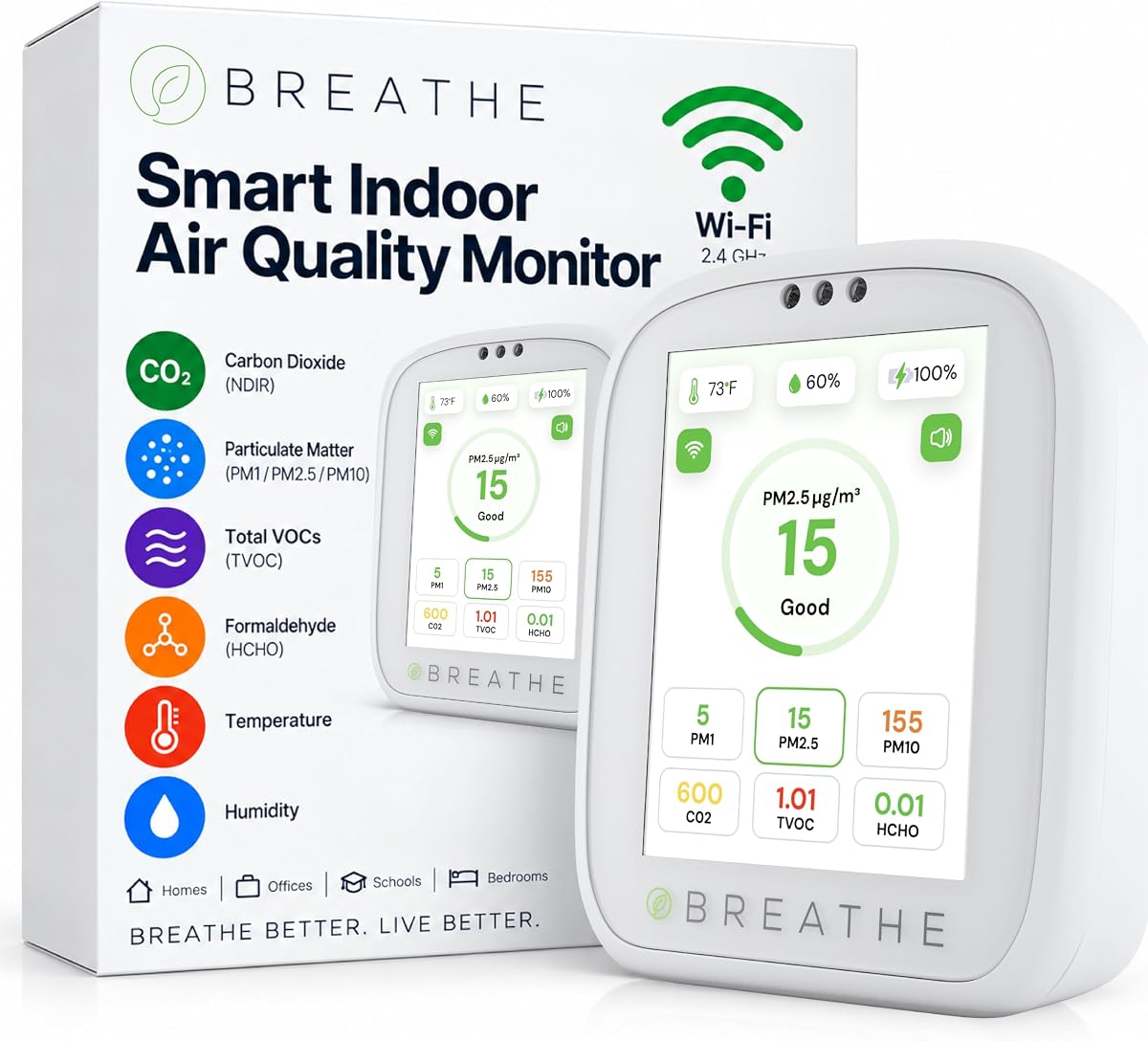
The BREATHE Airmonitor Plus Gen 2 is the most data-oriented monitor in this roundup, combining eight measurements with app-based history and export. Its 4.0 rating is supported by broad coverage: CO2, PM1, PM2.5, PM10, TVOC, formaldehyde, temperature, and humidity. The monitor uses NDIR CO2 measurement, laser particle sensing, and dedicated gas detection to build a detailed picture of changing indoor air.
We may earn a commission when you buy through this link, at no additional cost to you.
The free Breathe Tech app adds remote readings through 2.4 GHz Wi-Fi, configurable CO2 and PM2.5 alerts, historical graphs, and up to 90 days of stored data. Users can also export readings for longer analysis. That makes the device particularly useful for identifying patterns related to cooking, cleaning, occupancy, HVAC operation, and ventilation rather than merely checking a current number.
Gen 2 improves mobility with a rechargeable battery lasting up to six hours, while USB-C power allows continuous operation. A color display keeps information available directly on the unit. The trade-offs are app dependence, the need for 2.4 GHz Wi-Fi during setup and use, and a more advanced feature set that may be unnecessary for a room where only a quick PM2.5 or humidity check matters.
Choose the Airmonitor Plus when you want to understand why air quality changes over time. It is a strong fit for a home office, classroom, bedroom, family living area, or anyone conducting a ventilation experiment. It is also appropriate for users who need to retain readings and export them. For a simple display-only device, one of the portable 16-in-1 monitors may be more convenient.
Up to 90 days of stored readings allows users to compare ventilation habits, occupancy levels, and seasonal changes. Export adds another layer, making the monitor more useful for documenting trends over an extended period.
NDIR carbon dioxide measurement, laser particle sensing, dedicated TVOC detection, and formaldehyde monitoring provide a more complete environmental picture than a simple comfort display.
We may earn a commission when you buy through this link, at no additional cost to you.
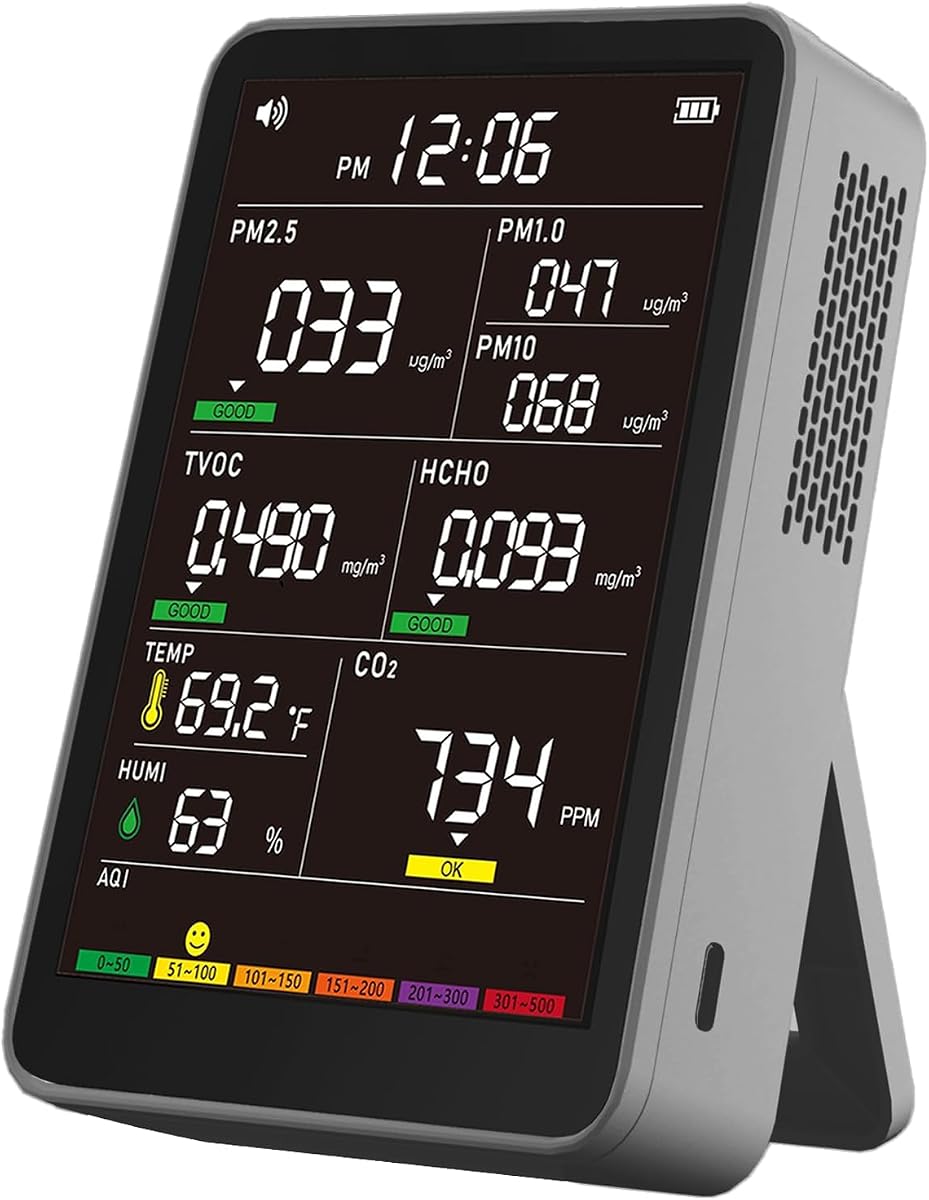
The 10-in-1 Smart Air Quality Tester earns the highest listed rating in the group at 5.0 while offering a notably portable design. It measures CO2, formaldehyde, TVOC, benzene, PM2.5, and PM10, with a stated error margin of less than plus or minus five percent. This combination gives it meaningful coverage for checking pollutants associated with cooking, cleaning, furnishings, and traffic-related odors.
We may earn a commission when you buy through this link, at no additional cost to you.
The HD LED color screen presents live values and automatically changes color when air quality exceeds a threshold. A smart chip and dedicated sensor array support detection, smart calibration, and stable sensitivity. Controls remain uncomplicated: a three-second press turns the unit on or off, and a one-second press changes the default Celsius reading to Fahrenheit. Full-range detection starts automatically after power-up.
Its 2,000 mAh rechargeable battery supports up to 20 hours of continuous use, making it the longest stated portable runtime among the monitors here. The lightweight form also works well for carrying between a home, car, plant area, workshop, or pet space. The absence of a stated app, remote access, and history means it is better suited to immediate readings than long-term analysis.
This is the most accessible option for users who need broad measurements without a complicated setup. Choose it for quick household checks, rental apartments, vehicles, or travel between spaces. It is also a practical choice for anyone who wants carbon dioxide and multiple gas readings in a compact unit. Users who need stored trends or automatic purifier control will find more capable connected options elsewhere in the guide.
A stated 20-hour runtime allows the monitor to cover a full workday or several room checks between charges. The compact build makes it especially useful when the most important room changes from home to office or vehicle.
The screen automatically shifts color when readings exceed a threshold, allowing users to notice a problem quickly. This is especially helpful when the monitor is placed across a room rather than watched continuously.
We may earn a commission when you buy through this link, at no additional cost to you.
The GoveeLife Smart Air Quality Monitor H5106 is a focused option for PM2.5, temperature, and humidity, with a 4.3 rating. It emphasizes quick, understandable readings rather than a large catalog of gases. The stated PM2.5 accuracy is plus or minus 15 micrograms per cubic meter, temperature accuracy is plus or minus 0.54 degrees Fahrenheit, and humidity accuracy is plus or minus three percent relative humidity.
We may earn a commission when you buy through this link, at no additional cost to you.
The display refreshes every two seconds, making it easy to see the effect of opening a window or changing a purifier setting. A top button cycles between clock and PM2.5 views, while a long press switches between bright and night modes. The LED indicator uses four ambient air quality levels, giving a quick summary without requiring careful reading of every number.
Its main strength is integration with the broader GoveeHome ecosystem. Compatible air purifiers, humidifiers, fans, and space heaters can turn on or off in response to changing air quality. The device also supports remote monitoring through Bluetooth or Wi-Fi, 13-day online graphs, and export of data over the past two years. It has no internal battery and uses a Type-C cable for power, making permanent placement straightforward.
Choose the H5106 if you own compatible GoveeLife equipment and want a small, affordable command center for PM2.5 and comfort. It is well suited to a bedroom, living room, or office with reliable power. However, it does not cover CO2, VOCs, formaldehyde, or multiple particle sizes, so people with broader environmental concerns should select a multi-parameter monitor.
Fast two-second updates make this model useful for checking whether a purifier or ventilation step is improving conditions. Its three essential readings are easier to interpret than a dense dashboard of less familiar gas metrics.
Compatible GoveeLife purifiers, humidifiers, fans, and heaters can respond automatically to air conditions. This creates a cohesive setup when the household already relies on multiple devices from the GoveeHome range.
We may earn a commission when you buy through this link, at no additional cost to you.
The 16 in 1 Air Quality Monitor combines nine displayed parameters with a 5.5-inch HD display and a 4.9 rating. It tracks CO2, PM2.5, PM1.0, PM10, formaldehyde, TVOC, temperature, humidity, AQI, and time. Seven distinct AQI alert functions provide timely feedback, making this model useful for people who want more visible detail than a basic three-measurement screen.
We may earn a commission when you buy through this link, at no additional cost to you.
External high-precision sensors and an enhanced airflow design are intended to capture changes quickly. The display has three brightness levels for different room conditions, and the temperature and humidity readings are stated at plus or minus one to three degrees Fahrenheit and plus or minus two to three percent relative humidity. Users can switch units by double-pressing the power button and silence alerts with the mute button.
The stated battery runtime reaches up to 10 hours, which is longer than most portable competitors here and suitable for moving the monitor through several spaces during a day. USB-C charging and an included AC adapter simplify recharging. As with other display-first options, no app, remote access, or stored history is mentioned, so its usefulness is concentrated in live readings and immediate alerts.
This monitor is a good option for bedrooms, offices, vehicles, and campsites where CO2 and a range of particle and gas readings are important. It balances portability, screen size, and alert functionality particularly well. Those wanting to compare readings over time should choose a networked model such as the BREATHE Airmonitor Plus or Airthings View Plus.
The extended portable runtime lets users move the device between a bedroom, office, and vehicle without planning around a very short operating window. USB-C charging also aligns with common cable choices.
Seven AQI alert functions cover a wider set of conditions than a single-threshold warning. The mute button gives users control over noise during meetings, sleeping hours, or other quiet activities.
We may earn a commission when you buy through this link, at no additional cost to you.
The Amazon Smart Air Quality Monitor 2-Pack is designed for households that want to compare conditions in two separate spaces. It carries a 4.2 rating and includes two monitors with the same five-factor coverage as the single-unit model: PM2.5, VOCs, carbon monoxide, humidity, and temperature. The stated information applies to each unit in the pack.
We may earn a commission when you buy through this link, at no additional cost to you.
Having one unit in a bedroom and another in a living room or office can reveal meaningful differences in air conditions. Both provide color-coded LED feedback, detailed Alexa app information, and an understandable air quality score. Phone notifications and Echo announcements can alert users when either location experiences poorer conditions, while Routines can activate compatible purifiers, dehumidifiers, and fans.
The two-pack does not solve the underlying limitations of the platform. It does not measure carbon dioxide, and it has no portable battery, so each unit should be placed where it can remain connected to power. The value of the bundle therefore depends on whether you genuinely need permanent readings in two locations. For a single room, a multi-parameter portable meter may be more versatile.
Choose this bundle for families or home offices comparing a common indoor space with a private room, such as a bedroom versus a nursery or living area. It is also useful for renters or households that want duplicate units without setting up each one separately. If the priority is long-term trends or rechargeable portability, consider the BREATHE or 10-in-1 alternatives.
Two units make it possible to determine whether particulate levels, humidity, or VOC readings are concentrated in one area. This is more informative than placing a single sensor in a central location where it may miss localized issues.
Each monitor can feed alerts and routines into the Alexa ecosystem. Compatible appliances can respond to local conditions, giving each room a more relevant response than a single whole-home automation.
We may earn a commission when you buy through this link, at no additional cost to you.
The second 16-in-1 Multi-Parameter Monitor in this list has a 4.9 rating and follows the same broad measurement approach as the other highly rated portable model. It monitors PM1.0, PM2.5, PM10, TVOC, formaldehyde, temperature, and humidity, giving users both pollutant and comfort data on one screen.
We may earn a commission when you buy through this link, at no additional cost to you.
A high-definition color display presents readings in real time, with color coding for air levels. The sensor array samples and processes data every 1.5 seconds, supporting quick feedback when a user changes ventilation or checks a different room. Its single-button design handles power and temperature unit switching, and a double tap turns off the audio prompt to create a quieter sampling mode.
The main limitation is the four-to-five-hour battery life. USB-C fast charging and the included AC adapter make the unit easy to replenish, but it is better suited to shorter checks than full-day portable use. Like the similarly focused 16-in-1 model, it does not offer a stated app, remote connectivity, historical graphs, or data export. Its strength is a self-contained visual experience.
Choose this monitor for bedrooms, home offices, classrooms, vehicles, campsites, plant rooms, and other spaces where a quiet, glanceable reading is useful. It works particularly well for short investigations of smoke, cooking fumes, cleaning odors, humidity, or dust. For continuous tracking and remote review, the GoveeLife, BREATHE, Amazon, or Airthings options provide more suitable connectivity.
Disabling the built-in audio prompt reduces interruptions during sleep, work, or study. The color display still provides visual feedback, so users are not dependent on audible warnings.
Measuring three particle sizes, two gas-related indicators, temperature, and humidity gives users a more complete snapshot than a PM2.5-only device. It supports quick decisions about ventilation and room comfort.
We may earn a commission when you buy through this link, at no additional cost to you.
The Airthings View Plus is the most specialized monitor in this guide, adding radon to a broad set of indoor measurements. It monitors radon, PM2.5, carbon dioxide, VOCs, humidity, temperature, and air pressure, while also providing live remote data through the Airthings app. Its 4.0 rating comes with substantial capabilities, although it is more dependent on its software ecosystem than the display-only competitors.
We may earn a commission when you buy through this link, at no additional cost to you.
Always-on sensors make it possible to track pollutants over time rather than just inspect an isolated reading. The app supports current conditions, trends, timely notifications, improvement tips, and local pollen information through Breezometer. Data is saved in the cloud for ongoing analysis. A customizable eInk screen offers a subdued, practical way to view information without the visual busyness of a bright color panel.
Setup is straightforward, but an Airthings account, email and name, and internet access are required. The device is battery powered, which allows cable-free placement in locations where an outlet is inconvenient, and its stated operating range is 39 to 104 degrees Fahrenheit. The optional extended warranty can raise the standard warranty to five years when registered. Compared with the portable models, it offers deeper long-term context but less immediate standalone simplicity.
Choose the View Plus when radon is a specific concern, particularly for homeowners, landlords, property managers, or anyone conducting an indoor air assessment. It is also compelling for users who want a comprehensive dashboard covering particles, gases, comfort, pressure, and time-based trends. If you only need an occasional visual reading, a portable multi-parameter monitor will usually be the simpler choice.
Radon monitoring fills a gap left by most conventional indoor air monitors. Because radon is a long-term residential concern, this feature makes the View Plus especially relevant for homeowners and real estate professionals.
The app keeps historical information available for review, helping users connect air changes with cooking, weather, occupancy, and ventilation. Remote access also means readings can be checked without standing beside the device.
We may earn a commission when you buy through this link, at no additional cost to you.
The right indoor air quality monitor depends on the pollutants that concern you, the room you want to understand, and whether you need immediate readings or long-term analysis. Sensor coverage, screen quality, connectivity, alerts, and power should be considered together.
A useful monitor should measure the conditions connected to your actual concerns. PM2.5 is central to understanding fine particles from cooking, dust, and combustion, while PM1.0 and PM10 add context about particle size. Temperature and humidity reveal comfort and mold-favoring conditions, and TVOC or formaldehyde readings can help track fumes from cleaning products, paint, adhesives, or furnishings. Carbon dioxide is valuable for identifying ventilation needs in occupied rooms, while radon requires dedicated detection and should not be assumed to be covered by a general VOC sensor. A broad list of labels does not guarantee that every important pollutant is measured accurately, so compare the actual detection list rather than relying on a headline such as 10-in-1 or 16-in-1.
Standalone displays are quick to read and work well when the device is placed across a room. A large screen with color-coded levels can communicate overall air quality at a glance, while local controls for units, brightness, and mute make daily operation easier. An app is more valuable when you need historical trends, remote readings, data export, or customizable alerts. Connected models can reveal patterns that a live display cannot, such as how outdoor air, cooking, cleaning, occupancy, or HVAC settings affect a room over time. The drawback of app-based devices is dependence on account setup, network compatibility, and ongoing connectivity, so check whether the app supports your phone and whether the monitor requires a particular Wi-Fi band.
Alerts should inform action rather than merely make noise. Look for configurable thresholds on the pollutants that matter most, such as PM2.5 or CO2, and consider whether the device offers audible buzzers, visual color changes, phone notifications, or voice announcements. A mute control is important in bedrooms and shared offices, while automatic routines can turn on a compatible purifier, fan, dehumidifier, or air purifier when readings worsen. More alert categories are not always better: a well-configured monitor with one meaningful threshold can be more useful than a noisy device that produces many irrelevant warnings.
Wired monitors are dependable for permanent locations and avoid battery aging, but they need a nearby outlet and cannot be moved easily. Rechargeable models support spot checks in a bedroom, car, workshop, or other room, and their stated runtime can range from a few hours to an entire workday. Longer battery life is useful for travel or mobile testing, while USB-C charging improves convenience. If the device will remain in one room and integrate with other equipment, wired power may be preferable. If you want to compare several spaces, portability is a central requirement rather than a minor convenience.
Accuracy specifications can be helpful when comparing sensors, but they often apply only to selected measurements. A product may quote a narrow temperature tolerance while providing no equivalent detail for CO2, particles, or VOCs. Reviews can also contain ambitious wording that should not be interpreted as laboratory certification. Look for transparent specifications, clear calibration guidance, and realistic expectations for consumer devices. Keep sensors away from direct contact, perfume, strong odors, dust, and moisture when the manufacturer recommends it. Placement also affects results: a monitor should usually be positioned away from a vent, direct sunlight, a window, cooking steam, or an air purifier outlet if you want readings that represent the room more evenly.
The most effective monitor for a bedroom may be quiet, compact, and able to identify PM2.5, humidity, and VOCs. A shared living room may benefit from a large display, voice notifications, and purifier automation. A bedroom, classroom, or meeting room with many occupants is a strong candidate for CO2 tracking because it can indicate whether ventilation matches occupancy. A vehicle requires portability and quick readings, while a basement or first-floor home may benefit from dedicated radon monitoring. A workshop, classroom, office, or nursery may prioritize different combinations of formaldehyde, particulates, temperature, and humidity, so choosing by room produces a more useful result than choosing solely by the largest number of functions.
Historical data distinguishes a momentary reading from useful environmental insight. A device that stores charts can reveal whether a purifier consistently lowers PM2.5, whether humidity rises overnight, or whether a meeting causes a CO2 increase. Retention periods vary from short graph windows to months of cloud storage, and export support is useful for deeper analysis or sharing findings. App-based history adds convenience but requires reliable connectivity and careful account setup. A display-only monitor is easier to operate and may be sufficient when you only need to compare a room before and after ventilation. Decide whether you need a dashboard, exportable records, simple alerts, or nothing beyond the current reading.
Smart-home integration can make a monitor more useful by connecting poor air readings to an air purifier, fan, dehumidifier, or compatible space heater. This works best within a clearly defined ecosystem, so check the manufacturer and model numbers of supported devices before buying. Voice assistants can also announce alerts, but they add another platform that must be configured correctly. Some integrations require cloud accounts, specific Wi-Fi bands, and compatible routines. A dedicated monitor with a broad sensor screen may be more dependable if the goal is measurement alone. Smart control is an advantage when you already own compatible appliances and want readings to prompt an automatic response.
Begin by deciding what the monitor needs to answer. Place it in a representative location at breathing height, away from direct sunlight, vents, windows, cooking steam, perfume, and other strong local sources that could distort readings. For a permanent installation, choose a spot where the display remains visible but the device is not frequently bumped. For portable testing, compare readings before and after opening a window, running a purifier, changing ventilation, or completing another activity. Give the sensor time to stabilize before interpreting a sudden change.
Set up the app, alerts, target values, display brightness, and temperature units according to your routine. If using smart-home routines, test them in a limited way first and make sure linked purifiers, fans, or dehumidifiers are compatible. A surge in particles after cooking or cleaning may be useful information rather than a sensor fault. Review trends over several days because one reading cannot reveal whether ventilation works consistently. Keep the screen and sensor openings clean, and follow the manufacturer instructions regarding calibration, charging, and placement.
Treat every indoor air quality monitor as an informational tool rather than a guaranteed life-safety system unless it is specifically certified and marketed for that purpose. The supplied information for at least one included 16-in-1 model explicitly states that it is not a smoke alarm or carbon monoxide alarm. Even devices that measure carbon monoxide should be evaluated for their intended certification and role. If readings suggest a serious persistent problem, smoke, a gas odor, or an unsafe environment, leave the area and contact the appropriate qualified professional or emergency service rather than relying only on the display.
The most useful measurement depends on the room and the concern. PM2.5 is broadly useful for fine particles, CO2 can indicate ventilation needs in occupied spaces, and humidity helps explain comfort and moisture problems. Formaldehyde, TVOC, and radon become more important when specific sources or risks are present. A good starting point is a device that combines PM2.5, temperature, and humidity, with CO2 added for shared or sealed rooms.
No, not unless a specific product is independently designed, certified, and marketed for that life-safety function. Some household monitors display carbon monoxide levels, but that does not automatically make them a substitute for a certified carbon monoxide alarm. One 16-in-1 model in this guide explicitly states that it is not a smoke alarm or carbon monoxide alarm. Always use approved alarms alongside an indoor air quality monitor.
Yes. In a closed bedroom, CO2 can rise as people breathe overnight and help indicate whether fresh-air exchange is adequate. It does not measure every possible pollutant, so it should be considered alongside PM2.5, humidity, temperature, and relevant gas readings. A monitor with CO2 alerts and historical graphs is especially useful for learning how quickly levels rise and fall during sleep.
It depends on what you want to learn. A monitor directly in the purifier's output can show how well the device performs, but it may not represent the rest of the room. A separate placement away from the outlet is usually better for measuring ambient conditions. Running a purifier and comparing readings from two locations can provide a practical way to assess both local effect and room-wide improvement.
The labels refer to particle size: PM1.0 is fine particulate matter, PM2.5 is also fine but slightly larger, and PM10 includes larger particles. Different sources produce different particle sizes, and a monitor with all three can show whether a change comes from fine combustion particles, dust, or larger airborne debris. PM2.5 remains a particularly important everyday indicator for many indoor environments.
No. Display-only monitors are often simpler and work well for live readings, color-coded status, and audible alerts. Apps add remote access, historical charts, data export, and more customizable notifications, but they also add setup requirements and connectivity dependence. Choose an app when long-term patterns matter; choose a standalone display for portable spot checks or a more self-contained installation.
Follow the manufacturer's guidance because calibration needs vary by sensor type and model. Some devices use automatic smart calibration, while others provide a manual process for particular sensors. Avoid touching exposed sensors and keep them away from perfume, aerosols, dust, and strong odors when instructed. Placing the monitor correctly and maintaining a clean sensor opening is often as important as performing a formal calibration.
A single monitor gives a useful snapshot of one location, but air quality can vary substantially by room. Kitchens, bedrooms, offices, and rooms near cooking, cleaning, or exterior doors can behave differently. Two units allow useful room comparisons, while a connected system or portable monitor can be moved as conditions change. The best number of units depends on building layout, local sources, and whether you need separate alerts for each room.
The strongest all-around choice is the 16-in-1 Indoor Air Quality Monitor because it combines broad pollutant coverage, rapid updates, a large color display, simple controls, and portable construction. For the lowest-cost starting point, the 10-in-1 Smart Air Quality Tester offers a strong customer rating, carbon dioxide measurement, and a useful 20-hour battery. The BREATHE Airmonitor Plus Gen 2 stands out for people who need app-based history, exportable data, and detailed analysis.
Prioritize the measurements and alerts connected to your actual environment, then choose between a standalone display and a connected model based on how you will use the information. Select a large screen for shared rooms, a long battery for moving between spaces, and smart routines only when the linked appliances are compatible. Radon, CO2, and life-safety functions should be evaluated as specific requirements rather than assumed from a multi-function label.
Finally, confirm the current listing, technical details, included accessories, app requirements, and availability before purchasing. Prices and product configurations can change over time, and the latest seller information may differ from an earlier listing. Reviewing the current product page alongside the strengths and limitations in this guide will help you select the indoor air quality monitor that best fits your room, priorities, and routine.