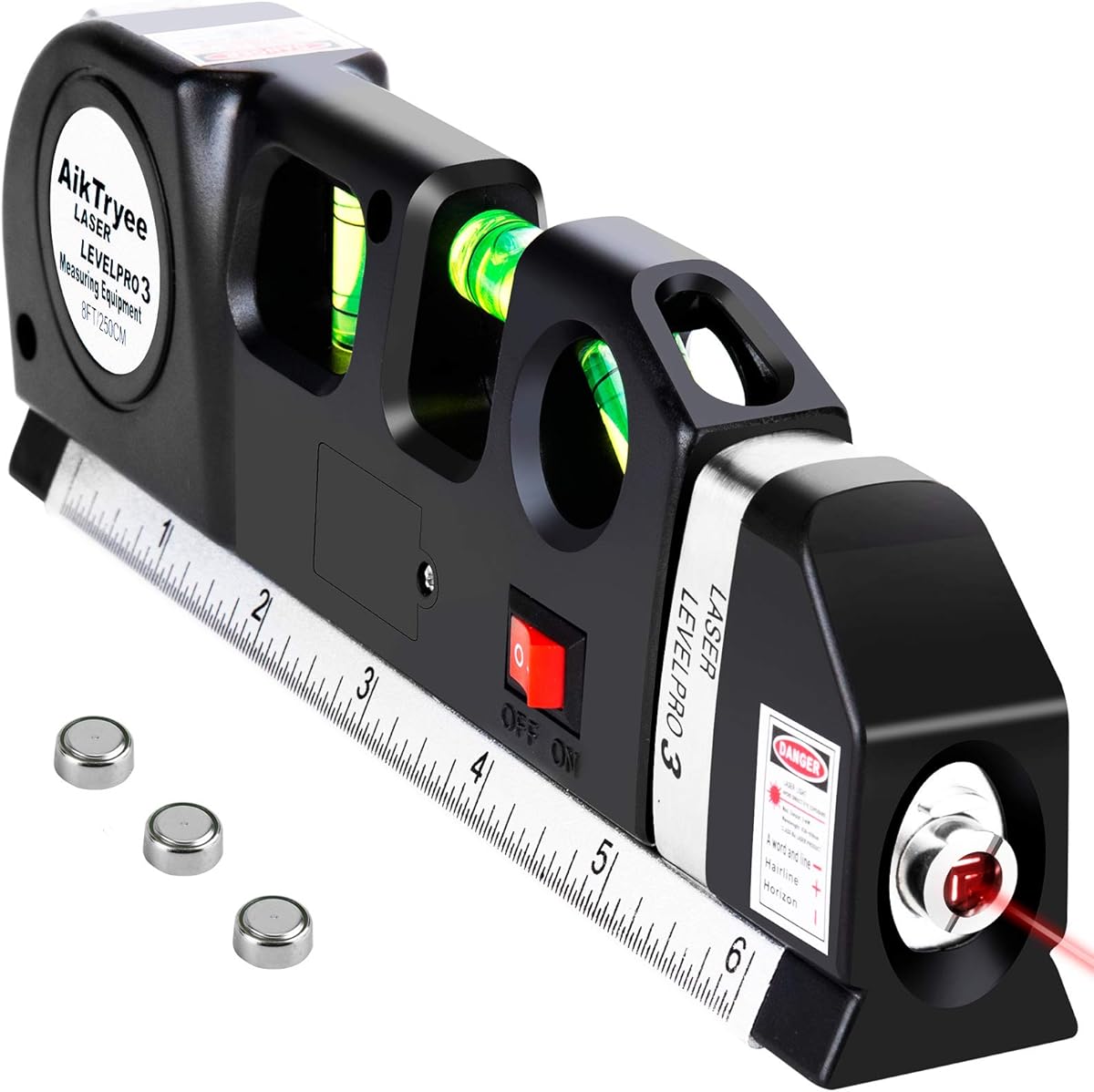
AikTryee Laser Level Line Tool
4.3Editor score
Manual horizontal and vertical lines
Built-in eight-foot measuring tape
Three-pronged bubble alignment system
Simple slider line selection
Discover the best laser level for hanging pictures, with 10 expert-reviewed options compared for accuracy, visibility, mounting, and ease of use.
Hanging pictures looks simple until several frames must share the same straight line. A laser level removes guesswork by projecting a bright reference line across the wall, making it easier to position nails, shelves, cabinets, artwork, and decorative groups with confidence.
We compared ten laser levels using the supplied specifications, focusing on beam visibility, accuracy, self-leveling behavior, mounting options, power, range, and included accessories. The list covers budget manual tools, compact green-beam models, tripod kits, and more advanced all-around units for demanding projects.
Each review explains the strongest reasons to choose a model, along with practical limitations and ideal users. Ratings reflect the supplied product feedback, while product availability and prices can change, so readers should confirm current details before making a purchase.
4.3Editor score
4.5Editor score

4.6Editor score
The comparison below highlights the most important differences among the ten options, including projection style, accuracy, power source, mounting flexibility, and the accessories supplied for picture-hanging and general DIY work.


The Motovera 100ft Green Cross Line is a versatile self-leveling laser level rated 4.2 by customers, with a supplied tripod, carry bag, batteries, and manual. Its most immediately useful feature for picture hanging is the vivid green cross-line, which is described as remaining visible indoors up to 100 feet and offering four brightness settings for changing ambient light.
We may earn a commission when you buy through this link, at no additional cost to you.
The stated accuracy is plus or minus 1/9 inch at 33 feet, accompanied by a wide 110-degree projection angle and self-leveling operation within four degrees. A manual mode allows users to lock the pendulum and project angled lines for staircases, patterned walls, and creative layouts. Four brightness modes and a pulse function add flexibility when the standard green line is difficult to see.
The kit is well suited to users who want more than a pocket-sized indoor helper. Its IP54 dust and water resistance, soft-grip body, and stated drop resistance make it appropriate for a broad range of household and job-site tasks. The included adjustable tripod removes the need to buy mounting equipment separately, although the line's tiny discontinuities caused by the protective acrylic window should be understood as normal.
This is a practical choice for hanging multiple frames, installing shelves, laying out tile, or working on general construction projects. It is especially attractive for buyers who want a self-leveling and manual tool with a complete accessory set. Users working mainly in bright outdoor conditions should understand that the stated indoor visibility and pulse capabilities may require better ambient conditions or additional detection equipment.
The green diode produces a vivid cross-line that is easier for many users to see than a conventional red line, particularly in occupied rooms. Four brightness modes let the user balance visibility against power use, while pulse mode supports more difficult lighting conditions.
Self-leveling handles ordinary horizontal and vertical placement, while locked manual mode expands the tool's usefulness to angled layouts. The flashing behavior in manual mode and outside the self-leveling range is intentional rather than evidence of a defective unit.
We may earn a commission when you buy through this link, at no additional cost to you.
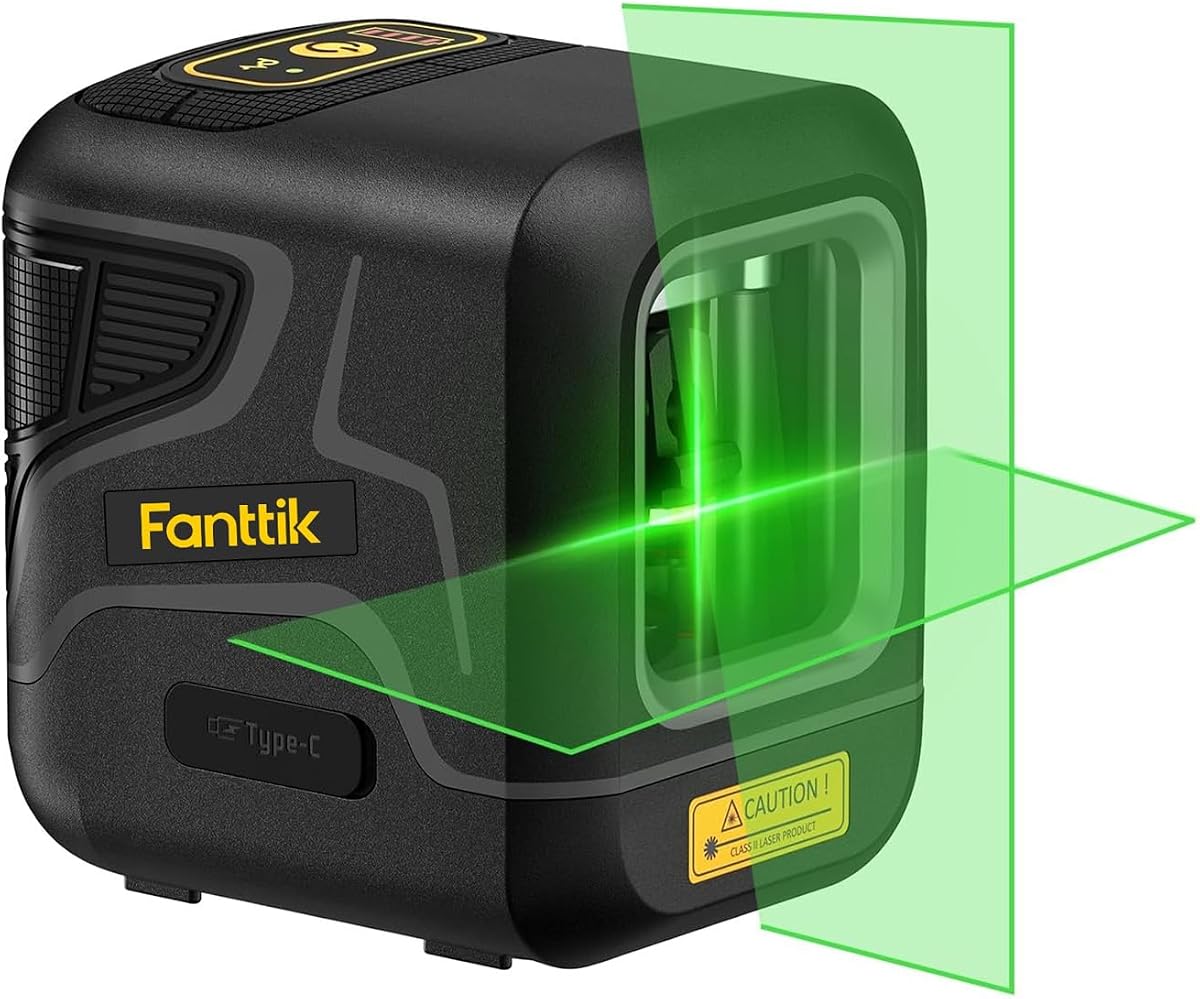
The Fanttik D2 Pocket Green Laser Level carries a 4.5 customer rating and stands out as a compact, cordless option designed directly for picture hanging and home DIY. It projects a bright green cross-line, weighs only 0.56 pound, and includes a magnetic bracket that can attach to compatible metal surfaces and rotate through 360 degrees.
We may earn a commission when you buy through this link, at no additional cost to you.
Its integrated 2200 mAh rechargeable battery provides up to ten hours of continuous use, while the included USB-C cable makes charging straightforward. Stated accuracy is within 1/8 inch at 30 feet, which is a useful level of precision for aligning artwork, floating shelves, and other household features. The self-leveling pendulum operates within four degrees, and locking it enables manual positioning at a chosen angle.
The D2 is not designed to be a full construction laser system, and its pulse-mode working range of up to 164 feet requires a receiver that is not supplied. Even without that receiver, the compact design and strong indoor green visibility make it more approachable for quick home tasks. Its TPE rubber covering also provides drop resistance without the bulk of a larger tool.
This is the top pick for someone who wants a small laser level that can move easily from picture wall to shelf project without disposable batteries. It also makes sense for renters, decorators, and homeowners who appreciate a magnetic mounting bracket and rechargeable operation. For users who require full 360-degree planes, it is better to consider the Huepar HM03CG; for simple wall alignment, however, the D2 is especially convenient.
The ten-hour rechargeable runtime removes the need to keep spare batteries nearby and makes the D2 simple to deploy for short or extended decorating sessions. Battery-status visibility helps users plan work around a charge, while USB-C charging adds flexibility at home or while traveling.
The included bracket can be fixed to a suitable metal surface and rotated as needed, providing a different approach from conventional tripod placement. This is particularly handy when a wall, shelf, or other object does not offer an easy place to set a freestanding tripod.
We may earn a commission when you buy through this link, at no additional cost to you.
The Huepar BOX-1G with Tripod is rated 4.4 and differentiates itself through a stated accuracy of plus or minus 1/13 inch at 33 feet, a 130-degree horizontal projection, and selectable single-line or cross-line output. For careful picture placement, the ability to turn off unnecessary lines can make the reference easier to interpret.
We may earn a commission when you buy through this link, at no additional cost to you.
The included 40-inch tripod extends from 11.4 to 40 inches and uses a 1/4-20 mount with a three-way pan head. It can swivel through 90, 180, and 360 degrees, allowing portrait or landscape positioning. A bubble on the tripod helps support stable placement, while the laser self-levels within four degrees when its pendulum is unlocked.
The tool also supports manual mode for angled work and pulse mode for bright indoor or outdoor conditions. It uses four AA batteries and offers an eight-hour working time in single-line mode and up to nine hours when all lines are active. These are strong specifications for a compact kit, though outdoor operation is less straightforward because the line can become difficult to see in strong sunlight without a compatible receiver.
The BOX-1G is well suited to users who want more precision and output choices than a simple manual line level. It is a particularly good fit for hanging a gallery wall, aligning multiple shelves, and handling tile or general renovation work. The included tripod is best kept on a flat indoor surface, so buyers who need rugged outdoor positioning should plan on a more stable tripod.
Selectable single-line mode is helpful when a horizontal or vertical reference is all the work requires, because fewer active lines can make the target easier to identify. Cross-line mode is available when the project needs both reference planes at once.
The tripod's extendable aluminum design and three-way head provide useful height and angle adjustments. Its bubble indicator assists with setup, while the laser handles fine self-leveling within its specified range.
We may earn a commission when you buy through this link, at no additional cost to you.
The Huepar HM03CG 3×360 has the highest customer rating in this group at 4.6 and offers the most expansive projection system. It creates one full 360-degree horizontal line and two full 360-degree vertical lines, allowing users to establish reference planes around a room rather than only on one wall.
We may earn a commission when you buy through this link, at no additional cost to you.
Each line can be switched on or off independently, which is a major benefit when hanging several pieces at different heights. The green laser has a stated working range up to 98 feet and accuracy of plus or minus 1/9 inch at 33 feet. Its rechargeable battery provides eight hours of continuous use, while four indicators show remaining charge and charging protection helps prevent overcharging.
Mounting flexibility is another strength. A bottom 1/4-20 thread supports tripod use, and the included magnetic bracket offers 1/4-20 and 5/8-11 connections along with two nail holes. The unit self-levels within three degrees, can be locked for manual angled work, and includes a USB-C cable and hard carry case. Its ABS body and TPR rubber covering provide a soft grip and added protection.
This premium model is ideal for decorators, renovation projects, and anyone who repeatedly needs vertical and horizontal alignment in the same space. Its extra coverage and selectable lines justify choosing it over a simpler cross-line model for complex layouts. Users should avoid highly reflective surfaces such as mirrors, glass, and glossy tile, where laser reflections can produce apparent extra lines that may cause confusion.
The three-plane configuration is particularly useful for projects that need reference lines on multiple walls, around corners, or at several heights. Users can establish a full horizontal plane and add vertical planes only where they are needed.
The magnetic bracket, multiple threaded connections, and nail holes make the HM03CG adaptable to different working environments. A tripod is not included, so buyers requiring freestanding placement should account for that additional accessory.
We may earn a commission when you buy through this link, at no additional cost to you.
The Huepar 9011G 100ft combines a green cross-line with a stated accuracy of plus or minus 1/16 inch at 16.4 feet, making it a precise and compact option for hanging pictures, shelves, and tiles. It has a 4.3 rating, a soft-grip palm-sized body, and a wide 110-degree field of projection.
We may earn a commission when you buy through this link, at no additional cost to you.
The pendulum has two positions. Unlocking it enables automatic leveling within plus or minus four degrees, while locking it creates a manual mode for angled layouts. The self-leveling function activates in under three seconds, and a standard 1/4-20 thread allows the tool to be mounted on a tripod when the included magnetic bracket is not the most convenient solution.
Its green laser is described as offering up to twice the brightness of traditional red lasers, which helps visibility in normal indoor spaces. The package includes the laser, magnetic bracket, two AA batteries, a user manual, and a carry bag. It also has stated 47.2-inch drop resistance, making it suitable for users who want a durable tool without moving to a much larger model.
This level works particularly well for home decorators who value precision, compact storage, and a simple switch-based control. The magnetic bracket adds placement flexibility without a permanent wall mount. New users should remember that continuous flashing can indicate the tool is beyond its self-leveling range or is placed on an unstable surface, so checking the mounting position is part of correct operation.
The plus or minus 1/16-inch specification makes the 9011G attractive for projects where visual alignment needs to be especially clean. Its compact dimensions also make it easier to carry from room to room than a larger tripod-mounted unit.
Unlocking the pendulum allows the internal mechanism to level the projected lines. Locking it disables self-leveling for angled work, so the line should not be treated as a horizontal or vertical reference in that mode.
We may earn a commission when you buy through this link, at no additional cost to you.
The AikTryee Laser Level Line Tool is the budget pick in this roundup, offering a 4.3 rating and a deliberately simple approach to picture hanging. A front slider selects the vertical line, horizontal line, or combined cross-line, while a three-pronged design incorporates level, plumb, and 45-degree bubbles for manual positioning.
We may earn a commission when you buy through this link, at no additional cost to you.
Its most distinctive feature is the integrated eight-foot measuring tape, which includes both imperial and metric graduations down to 1/32 inch and 1 millimeter. That turns the device into a combined line guide and short measuring tool, useful for spacing frames, checking cabinet positions, and working on tile layouts.
The trade-off is that this is a manual line level rather than a self-leveling electronic unit. It does not automatically compensate for a tilted surface, so users must establish the reference carefully using its bubbles. It is also more limited in long-range and professional construction applications than the green-beam models with specified laser accuracy and broader projection ranges.
For a first home laser level, a single picture, or a small gallery arrangement, the AikTryee is easy to learn and carries less unnecessary complexity. It is also a practical choice for users who want a simple line tool without charging cables, extensive controls, or a separate tripod. Serious decorators working across an entire room may eventually prefer a self-leveling cross-line model.
A single front slider handles the available line modes, reducing the learning curve compared with more complex electronic tools. Users switch on the line they need, position the tool against its bubbles, and mark along the projection.
The built-in tape removes the need to reach for a separate ruler during common measuring and layout tasks. Its dual scales support both inch-based and metric workflows, while the bubble aids complement the laser reference.
We may earn a commission when you buy through this link, at no additional cost to you.
The ZANIS Multi Surface Laser takes a different approach from typical self-leveling units by focusing on mechanical wall attachment. It has a 4.0 customer rating and projects an indoor laser line up to 30 feet. Dual adjustment dials provide one-degree increments for horizontal, vertical, and angled positioning, while a built-in bubble supports setup.
We may earn a commission when you buy through this link, at no additional cost to you.
The supplied MountBase allows three different attachment methods. Pins suit drywall, soft wood, and plywood; a built-in screw slot works on hard or rigid surfaces or any wall with an existing screw; and fourteen reusable adhesive pads are intended for smooth, non-porous materials such as ceramic tile, glass, metal, and smooth wood. The laser itself, MountBase, pads, pins, screwdriver, handle, batteries, and setup access are included.
This design is helpful when the user wants a reference line at a specific height without placing a laser on the floor or furniture. It is also useful for angled layouts, since the dials permit controlled adjustment. However, the adhesive pads must not be used on painted drywall, plaster, wallpaper, or textured walls, and selecting the wrong mounting method can compromise the security of the setup.
The ZANIS is best for indoor decorators comfortable choosing a mounting approach based on the wall material. It can simplify hanging pictures, shelving, tile, and cabinetry without a tripod. Those who want a fully electronic self-leveling system, a brighter long-range beam, or greater freedom of placement may prefer one of the green cross-line models, but ZANIS offers a particularly versatile wall-based method.
Wall material determines whether pins, a screw, or adhesive pads are appropriate. Using the intended method for each surface improves stability and helps prevent damage or detachment during a project.
The dual dials and one-degree increments make small angle corrections possible without relying on automatic leveling. The integrated bubble provides a visual check that the mounted tool is properly oriented.
We may earn a commission when you buy through this link, at no additional cost to you.
The Lusweimi 50-Inch Tripod Kit offers a balanced package for hanging pictures and tackling home renovation work. It includes a compact green cross-line laser, a 50-inch tripod, four AA batteries, a manual, and a carry pouch. The laser has a 4.2 customer rating and a stated accuracy of plus or minus 1/9 inch at 33 feet.
We may earn a commission when you buy through this link, at no additional cost to you.
The tripod provides greater working height than many compact kits, and its bubble helps with initial setup. The tool self-levels within plus or minus four degrees and switches to a locked manual mode when angled projection is required. Its green beam is described as twice as bright as a red laser under the same light source, supporting easier visibility in occupied indoor spaces.
The unit is relatively small at 49 by 65 by 65 millimeters and weighs 0.17 kilogram, so the laser itself remains easy to carry. An IP54 protection rating covers resistance to dust and water as well as shock and wear. The included four AA batteries provide two for operation and two spares, although users who dislike disposable batteries may favor a rechargeable option.
This kit is a strong match for homeowners who want more placement height than a small magnetic tool can offer. It works for wall art, shelves, and broader renovation tasks where a cross-line is sufficient. It does not project full 360-degree planes, so a decorator working around multiple walls may eventually want a more advanced model.
The 50-inch tripod can place the reference line closer to the desired hanging height than a compact tool resting on a shelf or table. This reduces awkward repositioning when aligning artwork across a larger wall.
The laser body is compact and light, while the included pouch makes storage between rooms straightforward. Users can carry the tool and tripod as separate pieces when moving to the next decorating task.
We may earn a commission when you buy through this link, at no additional cost to you.
The Rechargeable 100ft Green Cross Line combines cordless operation with a two-wire aluminum tripod and has a 4.4 customer rating. Its built-in lithium battery is stated to last six to eight hours, while the included Type-C cable allows charging from a USB port. A single control manages power and mode selection for quick setup.
We may earn a commission when you buy through this link, at no additional cost to you.
The tool projects horizontal and vertical green lines with a stated accuracy of plus or minus 3 millimeters at 10 meters and a 110-degree projection angle. The supplied information describes strong indoor visibility up to 30.5 meters, although the exact appearance of the line will depend on lighting and distance. Self-leveling operates within plus or minus four degrees, and locked manual mode supports angled layouts.
The tripod extends from 15 to 46 inches and has a 360-degree rotating, 90-degree tilting three-way head. A standard 1/4-20 mount secures the laser, while the wider wire construction allows the unit to be positioned at a practical height. Users should interpret continuous flashing outside the self-leveling range as an alert and check the surface or tripod setup.
This is a good all-around option for someone who wants rechargeable convenience but also values a substantial tripod. It is suited to picture layouts, shelves, tiles, and general interior projects. The tiny gaps sometimes visible in the projected line are attributed to the protective acrylic emitter window and are stated not to affect accuracy, so users can focus on the overall reference rather than those small interruptions.
The internal lithium battery removes routine battery replacement and provides enough stated runtime for most decorating or installation sessions. Charging over Type-C also makes it convenient to power from a laptop, power bank, or similar source.
The 360-degree pan and 90-degree tilt give users freedom to aim the cross-line around a room. Its broad height range supports floor-level, furniture-level, and higher wall reference positions.
We may earn a commission when you buy through this link, at no additional cost to you.
The Huepar 9011G with Tripod is a ready-made kit for users who want both a laser level and the accessories needed for common picture-hanging tasks. It carries a 4.3 rating and includes a 100-foot self-leveling green cross-line laser, magnetic bracket, portable tripod, two AA batteries, eight picture-hanging strips, a manual, and a carry bag.
We may earn a commission when you buy through this link, at no additional cost to you.
The laser has a stated accuracy of plus or minus 1/9 inch at 33 feet and a 110-degree projection field. It self-levels within four degrees, activates in under three seconds, and can be mounted through its 1/4-20 thread. Locking the pendulum provides manual mode for angled lines such as staircase or decorative-pattern layouts.
The included tripod is designed for home and indoor use on a flat, windless surface. It has a 1/4-20 mount and three-way pan head with 90, 180, and 360-degree swivel movement. Because its height is limited, it can be placed on suitable furniture to obtain additional elevation. The picture-hanging strips add a practical extra for mounting compatible frames.
This bundle is attractive for a new homeowner or renter who wants an all-in-one package for decorating several rooms. The green beam is easier to see than many red alternatives, and the magnetic bracket expands placement options. Users needing a full 360-degree room laser or rechargeable power should look farther up the list, but for routine picture and shelf alignment this kit is notably complete.
The package includes eight picture-hanging strips, which complement the laser level's role in planning placement. Buyers should still verify wall compatibility and the weight limits of any hanging system before use.
The magnetic bracket allows quick positioning on suitable metal, while the tripod provides a freestanding option for the floor or furniture. The tripod's pan and tilt adjustments help direct the line without moving the entire unit.
We may earn a commission when you buy through this link, at no additional cost to you.
The best laser level for hanging pictures is the one that combines a visible line, dependable leveling, secure placement, and controls suited to the user's experience. Accuracy matters, but mounting stability, beam color, power, and included accessories often have a greater effect on a real decorating project.
Prioritize a green cross-line for general indoor decorating if visibility is your main concern. Red and manual line tools can still work well in controlled lighting, while pulse mode may improve the usefulness of some units in difficult conditions.
Choose a self-leveling unit for repeatability and easier setup, but keep the tool on a stable, level surface. A self-leveling laser cannot compensate for a seriously tilted or unstable mounting point.
Match the mount to the job rather than assuming one method fits every space. Stability and correct surface selection are more important than owning several mounting options that are rarely used.
Most homeowners need a dependable cross-line. Choose multiple full 360-degree planes only when the project genuinely involves a room-wide layout, cabinetry, ceiling work, or repeated alignment on several surfaces.
Choose rechargeable power for regular use and disposable batteries for occasional, lightweight projects. Check the charging method and battery indicators before working in a location where a depleted tool would be inconvenient.
Focus on clear line visibility at the distance you will actually work. Do not purchase for outdoor detection work without confirming that a suitable receiver is included or planning to buy one separately.
Review the package contents before buying to avoid duplicating accessories or discovering that a tripod is missing. Longer support terms can add reassurance, but accuracy, stability, and visibility remain the primary performance factors.
Begin with the controls relevant to the project, read the manual, and keep the laser away from reflective materials when possible. A tool that the user understands will generally produce better results than one with additional features they do not need.
Begin by selecting a clear work area and checking the wall for obstructions, outlets, switches, studs, or other features that may affect placement. Charge a rechargeable model or install the specified batteries, then place the laser on a stable, level surface. For a tripod, tighten the legs and use the tripod's bubble or other indicators to establish a stable platform before switching on the laser.
Unlock the pendulum or choose self-leveling mode when a horizontal or vertical reference is required. Position the line over the intended nail or hook location, allow the unit to settle, and mark the beam at the appropriate points. Move the tool carefully if additional points are needed, and always verify that it has returned to the same stable setup. For angled decoration, lock the pendulum for manual mode, but do not treat that line as a level reference.
After the project, switch the laser off before removing the batteries, pack it in its case, and store it in a dry area away from extreme temperatures and impact. Clean the laser window with a soft, dry cloth, avoid solvents or abrasive materials, and remove batteries from a long-unused unit. Check the line, mount, and controls periodically, since a loose tripod head or dirty optical window can quickly undermine an otherwise accurate setup.
A self-leveling laser is convenient because it reduces setup time and helps maintain a consistent horizontal or vertical reference. It is particularly useful for gallery walls, multiple frames, and long shelves. A simple manual line level can still be sufficient for one frame or a small project, provided the user checks its bubble levels carefully.
Many users find green lines easier to see, and several products in this guide are described as brighter than red lasers under the same light source. Visibility also depends on room lighting, distance, wall finish, and the user. A green model is a strong choice for busy rooms, while a red or manual model can remain perfectly serviceable in controlled conditions.
Continuous flashing usually means the tool is tilted beyond its self-leveling range or is sitting on an unstable surface. A periodic flash in locked manual mode is a normal reminder that the pendulum is no longer providing a level reference. Check the placement, unlock the pendulum for horizontal or vertical work, and consult the product instructions if the behavior continues.
A tripod is useful when the line needs to be positioned at a specific height, above furniture, or across a larger room. For a compact wall project, the included magnetic bracket or wall-mounted system may be more convenient. If you already own a tripod with a compatible 1/4-20 mount, verify the specifications before buying another one.
Yes, and that is one of the main advantages of using a laser reference. Mark the line at each desired position, verify the measurements from a fixed point, and make each mark before moving the tool. For a gallery wall, use the measuring tape or another ruler to confirm the spacing between frame centers and edges.
Often, yes. Strong sunlight makes a visible green line harder to follow, and several pulse-mode working ranges apply only when a compatible receiver is used. None of the listed standard packages should be assumed to include a detector, so check the product specifications and accessory requirements before relying on an outdoor range.
Self-leveling mode uses an internal pendulum to establish a horizontal or vertical reference automatically within a specified range. Manual mode locks the mechanism so the user can position the line at a chosen angle, which is useful for stairs and decorative patterns. Lines shown in manual mode should not be treated as level references.
The laser itself projects light and does not physically mark most painted walls, but mounting accessories can cause damage if used incorrectly. Follow the wall-type instructions for pins, screws, and adhesive pads, and do not use the pads on painted drywall, plaster, wallpaper, or textured surfaces unless the manufacturer explicitly permits it.
The Fanttik D2 is the most convenient all-around choice for quick indoor decorating because it combines a green cross-line, rechargeable power, and a rotating magnetic bracket in a compact body. The AikTryee tool is the practical budget selection for a simple manual line guide, while the Huepar HM03CG is the premium option for decorators who need three full 360-degree planes and more advanced placement options.
Most buyers should prioritize visibility at the intended working distance, stable mounting, and a self-leveling range that fits the project. A two-line cross reference is enough for many picture-hanging tasks, while full-room coverage becomes valuable when aligning multiple walls, shelving, cabinets, tiles, or ceiling features. The included tripod, bracket, case, and picture-hanging strips can add convenience but should not outweigh core accuracy and stability.
Before purchasing, compare the current product details, package contents, ratings, accessories, and warranty terms. Product prices and availability change over time, and optional receivers or additional tripods are not included with every model. Checking those details at the time of purchase helps ensure that the selected laser level matches both the project and the budget.