
Windtrace Automatic Pill Dispenser for Elderly with Alarm
4.0Editor score
Twenty-eight medication compartments
Six daily dosage schedules
Loud audible visual alerts
Our Automatic Pill Dispenser guide compares 10 models for alerts, dosing flexibility, security, app support, ease of use, and home medication storage.
Automatic pill dispensers combine timed reminders, organized medication storage, and controlled access to make daily routines more consistent. A useful model should suit the user’s dosing schedule, remain easy to operate, and provide alerts that are noticeable without becoming stressful. The right choice depends as much on mobility, vision, and caregiving needs as on capacity.
We compared all 10 products by examining capacity, alert options, dosing flexibility, lock design, app connectivity, moisture protection, filling process, and accessibility. The list covers basic rotating carousel dispensers, tray-based systems, and connected models with remote monitoring. It also distinguishes between home-only products and devices specifically described as suitable for care facilities.
Each review explains the dispenser’s strongest benefits, practical limitations, and likely users. The top picks represent the strongest all-around options for different priorities, including straightforward operation, connected care, and advanced organization. Product availability and prices can change, so check the current listing before making a final purchase or comparing your budget.
4.0Editor score

4.2Editor score

4.2Editor score
The table below compares all 10 dispensers across their most important practical features: capacity, dosing configuration, reminder methods, access control, and connected monitoring. It is designed to make it easier to identify the right format for a single daily dose, multiple daily doses, independent home use, or caregiver supervision.



This 28-day automatic pill dispenser is the strongest all-around choice for a person who takes one scheduled dose each day and values straightforward operation. It replaces a traditional rotating disc with a slide-door tray: pressing one button releases the day’s medication into a cup. That design avoids lifting, tipping, and rotating a loaded carousel, which can be difficult for people with weak grip strength or shaky hands.
We may earn a commission when you buy through this link, at no additional cost to you.
The dispenser supports sound-only, light-only, or combined sound and light reminders. A bright LED ring and clear beeps provide noticeable alerts in different living environments, while the timing window allows a dose to be taken 15 minutes early or 30 minutes late. Storage is another major strength. A water-resistant lid, sealing silicone structure, and two desiccant chambers are designed to protect medication from humidity, particularly in warmer or more humid settings.
Its 28 compartments can accommodate a mixture of common tablets, vitamins, and capsules, making it practical for many single-dose routines. However, each slot represents one daily dose rather than a full morning, afternoon, and evening cycle. There is also no app, remote monitoring, or advanced adherence log. Gummy-style capsules are not recommended because they may stick to the compartments. Finally, the manufacturer states that the product is intended for home use and is not suitable for assisted living facilities, nursing homes, or other regulated institutions.
This is the recommendation for users who want fewer mechanical steps and fewer technology distractions. A caregiver can fill 28 days at once, configure the reminder, and then rely on the physical release mechanism without expecting the user to rotate a carousel. For people with several medicines taken at different times, a multi-dose model may be a better match.
The one-press slide-door release is especially useful when dexterity is limited. Medication falls directly into the cup, reducing the need to tip, shake, or manipulate a heavy tray.
The sealed lid, silicone structure, and dual desiccant slots provide several layers of moisture protection. They are especially relevant for bathrooms, warm climates, and extended 28-day fills.
We may earn a commission when you buy through this link, at no additional cost to you.
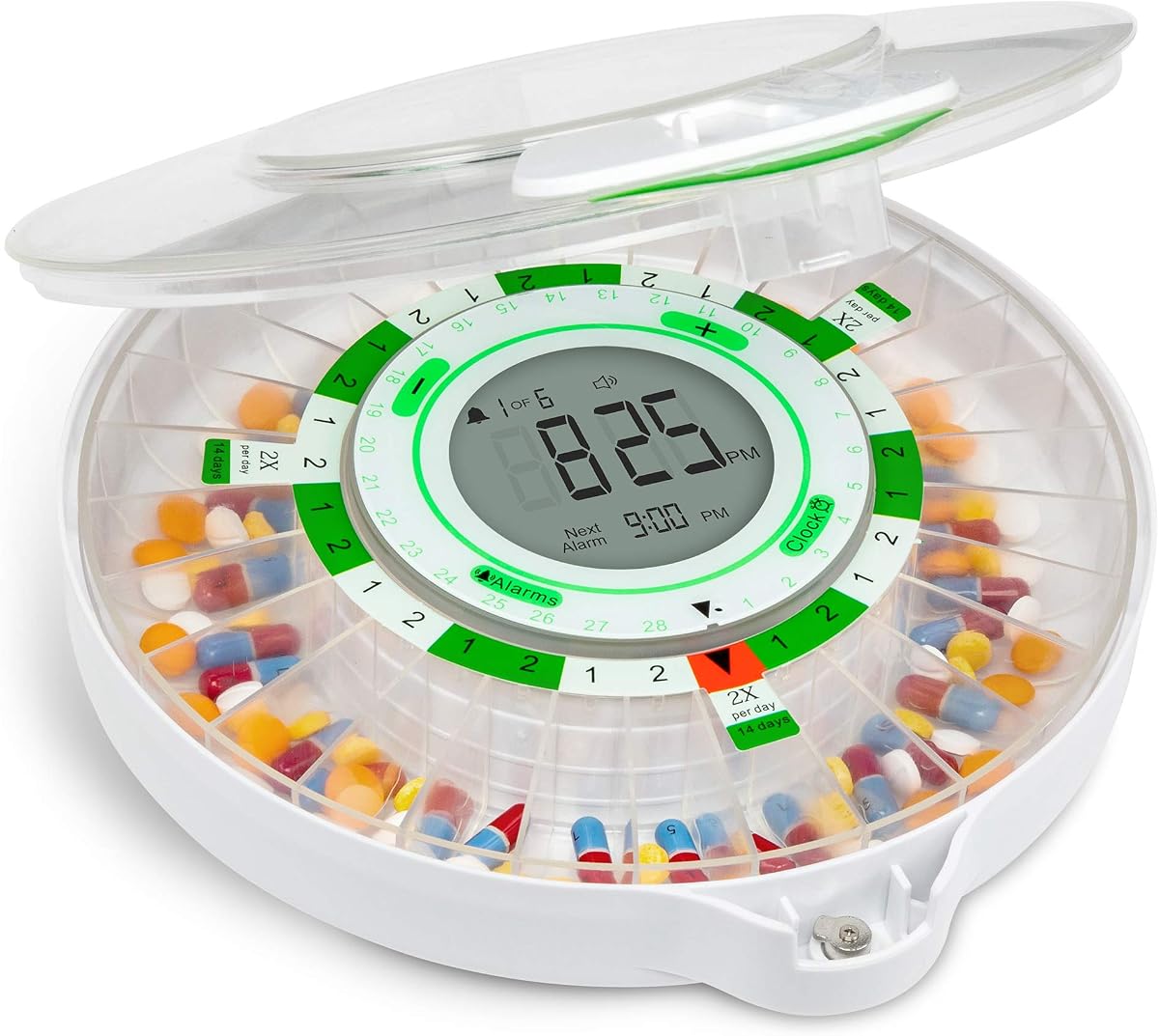
The Windtrace dispenser provides a practical mix of scheduling, visibility, and audible prompting without adding app-based complexity. It uses a 28-compartment rotating tray, with six dosage rings that support one to six reminders per day. This makes it more flexible than a strictly once-daily system and suitable for people who take medication in the morning, afternoon, evening, or at more frequent intervals.
We may earn a commission when you buy through this link, at no additional cost to you.
Its alarm combines a loud sound with a bright flashing blue light. The LCD screen is designed to be easy to read, and the tray’s transparent lid allows a caregiver to check what has been filled or dispensed without opening the machine. The removable tray is made from food-grade materials, while the smooth sliding retrieval window makes medication access more comfortable for seniors and people affected by arthritis.
The main compromise is the traditional carousel format. Filling and advancing the schedule still requires rotating the tray, which may be less convenient than the one-press slide-door mechanism used by the top-ranked model. There is also no connected app, remote caregiver monitoring, or historical adherence record. Nevertheless, the basic feature set is complete enough for independent home use, and the included manual and instructional video make programming more approachable.
This is a sensible choice for buyers who want dependable timed dispensing on a more restrained budget. It works particularly well for a user who can handle a rotating tray but benefits from both sound and light alerts. Caregivers can organize a month of medication in advance and rely on the removable tray for easier refilling and cleaning.
Six interchangeable dosage rings provide multiple daily reminder options. This gives the basic dispenser enough flexibility for common two- or three-times-a-day medication schedules.
The transparent lid lets users and caregivers inspect the tray at a glance, while the sliding window allows medication to be removed without lifting or tipping the container.
We may earn a commission when you buy through this link, at no additional cost to you.
The LiveFine 28-day dispenser is designed for people with several medications or a demanding reminder schedule. Its nine interchangeable dosage rings offer more scheduling flexibility than many conventional monthly pill organizers, allowing the unit to be configured for up to nine doses per day. A jumbo LCD display, simple button controls, and an easy-fill carousel make the system approachable without requiring technical setup.
We may earn a commission when you buy through this link, at no additional cost to you.
Reminder settings are among its most useful features. Users can choose from three volume levels and three beeping patterns, allowing the alerts to match hearing, noise levels, and personal preferences. The clear lid provides a visual view of the medication supply, while the lockable cover and manual key help prevent unauthorized access. The smooth sliding retrieval window is designed to improve access for people with limited dexterity.
The carousel format still involves physical rotation when moving through the schedule. Users must also check that the installed ring matches their medication schedule, and the absence of an app means caregivers cannot review intake history remotely. Nevertheless, the dispenser combines a generous number of compartments, strong customization, and a readable display in a conventional design.
Choose this model when alarm customization and high-frequency scheduling matter more than remote monitoring. It is a good fit for independent users who want more than one or two reminders per day and value a secure, visible carousel that can be filled and maintained at home.
Nine interchangeable dosage rings support up to nine reminders per day, making the unit useful for complex medication routines that exceed the schedule capacity of simpler dispensers.
Three volume levels and three beeping patterns let the user balance audibility with disruption. The large display provides a clear reference for the current time and programmed schedule.
We may earn a commission when you buy through this link, at no additional cost to you.
The 42-day expandable tray dispenser is the most advanced option in this guide, combining connected monitoring, remote configuration, and a flexible tray-based dosing system. Family members can use the app to establish dose times, review whether medication was taken, receive missed-dose notifications, and follow dosage history. The companion app requires no subscription and includes automatic software updates, making it unusually complete for a home medication organizer.
We may earn a commission when you buy through this link, at no additional cost to you.
Its three-tray system offers several useful interpretations. One tray with 14 slots can provide 42 days of once-daily medication. Two trays can support 14 days of twice-daily dosing, while all three can support 14 days of three-times-daily dosing. Each slot represents one dose, and the manufacturer says no manual rotation or dosage rings are required. This makes the design more adaptable than a fixed 28-slot carousel.
Setup can be handled remotely by a family member or locally through on-device buttons and voice prompts. The user can choose LED, voice, buzzer, or melody alerts. A sealed lid and built-in desiccant pack protect medication from humidity, while a digital lock, remote unlocking, and emergency dispensing add a higher level of access control.
This model is best suited to a household that wants meaningful caregiver oversight and is comfortable with app-based setup. It costs more in terms of complexity and may be unnecessary for a user who only needs a one-time daily reminder. The stated warning is important: the product is intended for home or non-institutional use and is not suitable for nursing homes or other regulated facilities.
The app supports schedule setting, intake checks, missed-dose alerts, adherence trends, and remote lock control without a recurring subscription. It is a meaningful upgrade for independent seniors with involved family caregivers.
The three interchangeable trays support once-, twice-, or three-times-daily configurations. The same hardware can therefore cover long one-dose cycles or shorter multi-dose routines without rotating rings.
We may earn a commission when you buy through this link, at no additional cost to you.
This two-tray connected dispenser provides a balanced version of remote medication management. The app lets family members set schedules, monitor intake history, and receive missed-dose alerts, while seniors can use on-device buttons and voice prompts if they prefer not to rely on a smartphone. The absence of a subscription keeps the connected features available without a recurring service charge.
We may earn a commission when you buy through this link, at no additional cost to you.
Each tray has 14 slots and represents one time of day, such as morning, noon, or evening. With one tray in use, the machine can cover 28 days of once-daily medication. With two trays, it can provide 14 days of twice-daily doses. This configuration is more adaptable than a single-compartment daily device but less flexible than the three-tray 42-day model.
The dispenser offers LED, voice, buzzer, and melody reminders. Its sealed lid and built-in desiccant pack support moisture-safe storage. A digital lock can be controlled through the app, and emergency dispensing can be performed remotely, which is useful when a caregiver needs to authorize access outside the normal routine.
This is a strong choice for a senior living at home with family members who want oversight but do not need the three-tray capacity. It offers the essential connected-care functions in a more focused package. As with the other expandable-tray products, it carries a home-use warning and is not intended for assisted living facilities, nursing homes, or regulated institutions.
Two trays cover the most common twice-daily medication routine while retaining a 28-day capacity for users who take only one dose. It bridges basic organizers and larger three-tray systems.
Real-time dose history and adherence trends can be viewed and shared with doctors or caregivers. The information is more useful when a family member needs a clear record of the user’s routine.
We may earn a commission when you buy through this link, at no additional cost to you.
This Windtrace version offers a familiar 28-compartment carousel with six dosage rings, a loud alarm, and a flashing blue light. It is a practical choice for users who need up to six daily reminders but do not need connected monitoring. The medication schedule can be programmed in minutes, and the large LCD display is designed to be legible for older users.
We may earn a commission when you buy through this link, at no additional cost to you.
The removable tray is made from food-grade materials and is divided into 28 large compartments. A transparent lid allows visual monitoring without opening the unit. For refilling and routine access, the lid opens easily and the smooth sliding retrieval window offers a more controlled way to reach medication. These details are particularly relevant for people with arthritis or reduced hand strength.
The included accessories add practical convenience. The package contains the dispenser, six dosage rings, three black keys, an instruction manual, and four AA batteries. The keys provide physical control over access, which can be useful in a home where medication security matters. However, there is no app, remote unlock, or historical record of which doses were taken.
This model is a good alternative for buyers who appreciate straightforward physical controls and do not need digital caregiver reports. Its main limitation is the same carousel rotation found in other traditional organizers. Users must also install the correct dosage ring for their schedule. For a person with a stable one- to six-dose routine, it provides an effective mix of visibility, prompting, and access control.
Three included keys make it easier to prevent unauthorized access. This is useful for users who value a tangible lock more than an app-based monitoring dashboard.
The 28 large sections can hold multiple pills and accommodate different medication cycles. The clear lid makes it easier for caregivers to inspect and replenish the tray.
We may earn a commission when you buy through this link, at no additional cost to you.
The Retekess TH017 combines a week-at-a-time schedule with unusually thorough reminder and power-failure features. Its 21 large, independent compartments can organize morning, afternoon, and evening doses for a full week. When an alarm sounds, the box pops open to present the medication cup, and the alert stops after the cup is removed. The LCD screen clearly shows medication information and helps the user follow the schedule.
We may earn a commission when you buy through this link, at no additional cost to you.
Reminder personalization is a major strength. Users can set specific times, select from three sound levels, and choose between 12-hour and 24-hour time formats. Loud voice alerts and bright light signals work together, making the notifications easier to notice in busy or noisy rooms. The light-resistant upper cover also helps shield medication from UV exposure, while dual mechanical locks provide physical security.
The power-off memory function is particularly useful because it preserves the programmed medication schedule after an outage. That reduces the risk of having to rebuild the entire routine. The principal limitation is capacity: 21 compartments represent one week of organized doses rather than the 28-day or 42-day supply offered by several carousel and tray models. The manufacturer also emphasizes that the reminder is only an auxiliary function and should not replace adherence to medical instructions.
This is a compelling pick for anyone who wants many alarm options, dependable schedule memory, and a week of clearly separated doses. It is especially attractive for a person with a stable weekly routine, while a monthly organizer may be more convenient for a caregiver who prefers to refill less frequently.
The power-off memory preserves the programmed schedule after an outage. Users can restart the device without needing to reconstruct every reminder time from the beginning.
Three sound levels, voice prompts, bright lights, and selectable time formats allow the reminder system to be adapted to hearing, visibility, and scheduling preferences.
We may earn a commission when you buy through this link, at no additional cost to you.
The LiveFine locking-lid model is a well-rounded monthly organizer for users who want many reminders, physical security, and a generous number of pills in each compartment. The 28-day carousel includes nine interchangeable dosage rings, supporting up to nine doses per day. Each slot can hold as many as 18 pills, which accommodates larger prescription quantities and multiple vitamins at a single dosing time.
We may earn a commission when you buy through this link, at no additional cost to you.
A jumbo LCD display, three volume levels, and audio plus visual alerts make the schedule easier to follow. The timer can be programmed as frequently as every 30 minutes, offering useful flexibility for short-interval medication routines. Setup uses an intuitive three-button interface, and the unit is battery-operated and portable, making it appropriate for home use or travel.
The manual-key locking cover helps prevent unauthorized access, and the sliding retrieval window offers smooth medication access for people with limited dexterity. Its limitations are conventional: the carousel must be physically rotated, there is no connected adherence history, and the user must confirm the proper dosage ring is installed. Remote caregivers cannot review intake or unlock the device from a phone.
Choose this model for a user who values a monthly fill, a large per-slot capacity, and substantial scheduling flexibility. It offers a clear, familiar design without app complexity, making it especially appropriate for independent users who can handle a rotating organizer and are comfortable programming the controls themselves.
Accommodating up to 18 pills per slot means several medications or vitamins can be grouped into one scheduled dose without forcing the user into a smaller auxiliary organizer.
Battery operation and a simple locking system make the dispenser relatively easy to carry. The programmable intervals and clear display help maintain the routine wherever it is used.
We may earn a commission when you buy through this link, at no additional cost to you.
The Live Fine clear-lid dispenser focuses on the fundamentals of monthly medication organization: visible storage, timed alerts, and an easy-fill carousel. It holds 28 days of medication and provides both audible and visual reminders, with up to nine customizable reminders per day. The large LCD is designed to be easy to read, while the clear lid lets a caregiver or user check the remaining supply at a glance.
We may earn a commission when you buy through this link, at no additional cost to you.
Its easy-fill carousel can accommodate as many as 18 pills per slot, which is useful for people taking several tablets, capsules, or vitamins at the same time. The sliding retrieval window supports smoother access and is intended to help users with arthritis or limited dexterity. A lockable cover and manual key add a layer of protection against unauthorized access.
This is not a connected device, so it cannot send missed-dose notifications, maintain a remote adherence log, or be configured from a smartphone. As with other carousel models, advancing the schedule involves physical rotation. The unit is also less suited to very short-interval scheduling than dedicated timer-cap products.
Choose it when a visible, secure monthly organizer with customizable alerts is enough. It is especially helpful for a user who wants fewer doses in each compartment than the maximum the machine allows, or for a caregiver who fills medication carefully and wants a quick way to inspect the remaining supply. The straightforward design reduces both cost and learning demands.
The transparent carousel makes the remaining supply easy to inspect. This is useful during weekly checks and reduces the need to open the lock or dismantle parts of the organizer.
The sliding window provides a controlled path to the medication cup. Combined with the large display and simple schedule controls, it reduces the physical and cognitive effort of daily use.
We may earn a commission when you buy through this link, at no additional cost to you.
The 21-Day Bluetooth dispenser uses individually rising medication pods to make access easier than a traditional carousel. At the scheduled time, the relevant medicine cup extends automatically so the user does not need to lift, tip, or shake medication from a compartment. This is especially helpful for seniors and people with arthritis who may struggle with a fixed tray or small sliding window.
We may earn a commission when you buy through this link, at no additional cost to you.
Bluetooth 5.0 connectivity pairs with an app for schedule control, reminders, and intake tracking. The app includes medication records for the previous 14 days, while eight alarms and eight dose rings support a flexible routine. Caregivers and users can organize vitamins, supplements, and medication, with a clear lid allowing visual monitoring. A loud alarm, flashing light, LCD screen, and support for 12- or 24-hour formats help keep the schedule visible and noticeable.
The key lock adds physical security, while individual pod design provides the potential for controlled access between doses. The package includes the dispenser, eight dosage rings, a key, batteries, a charger and cable, and three extra pods. Each pod can hold 12 capsules or fish-oil softgels and additional tablets or vitamins. Battery operation lasts for more than two months, and a plug-in option is included along with low-battery alerts.
This model stands out for rising-pod access, app-backed records, and a stated ability to suit senior residents in care facilities, caregivers, and home-care agencies. The main limitations are the 21-day main capacity and the extra setup required for app features. It is best for users who prioritize easy pod access and connected monitoring over a month-plus supply.
Automatically extending pods remove the need to manipulate the entire organizer. The raised cup is easier to see and reach, improving access for seniors and people with limited hand mobility.
The app stores 14 days of medication records, while eight reminder settings provide schedule flexibility. Extended battery life and plug-in operation support reliable use between charges.
We may earn a commission when you buy through this link, at no additional cost to you.
The right automatic pill dispenser depends on medication frequency, mobility, alert needs, and the level of oversight available. Compare capacity and dosing patterns first, then examine access, storage, setup, and any connected features before deciding.
Capacity should reflect both the number of doses per day and how often a caregiver is willing to refill the machine. A 28-compartment carousel often works well for one dose per day, but the same number of compartments may represent only about two weeks with two daily doses. Tray-based models can reconfigure their schedule, while the 21-day rising-pod design focuses on individual cup access. Check the meaning of every slot and the stated number of days under your required schedule before buying.
Choose enough space for a complete fill without excessive handling, and confirm that the compartments can hold your pills. Capacity alone does not guarantee a good fit.
Dosing-ring systems range from six flexible schedules to nine, while connected tray models use separate trays for different times of day. The Retekess TH017 also supports eight alarm configurations. Consider how many medication times exist, how long the schedule must remain unchanged, and whether a caregiver will modify it remotely. A user with only one stable daily dose may prefer a simpler system, while someone with several daily medications benefits from finer scheduling control.
More alarms are useful only if the user can distinguish them. Simple, consistent reminders often work better than a complex configuration that no one maintains.
The strongest systems combine audible and visual prompts, allowing the user to notice a reminder through either hearing or sight. Some models offer multiple volume levels, beeping patterns, voice guidance, buzzers, or melodies. Think about the user’s hearing, vision, bedroom lighting, and the noise level of the room. A loud alarm may be necessary in a busy home, but adjustable levels can prevent it from becoming distressing.
Test the selected alert mode with the intended user. A display that is easy to read and an alarm that is noticeable are more valuable than multiple options the user never configures.
Physical access varies dramatically across the guide. One-press slide-door release, rising pods, and smooth retrieval windows are easier for people with weak grip strength or shaky hands. Traditional carousels require lifting and rotating the tray, which can be less accessible but may remain familiar and straightforward. The locking mechanism also matters: a manual key, digital lock, or app-controlled lock should be usable by the intended caregiver without becoming an obstacle during an urgent dose.
Prioritize the simplest mechanism the user can operate repeatedly. A secure feature is helpful only if it does not prevent timely access.
Connected dispensers can set schedules remotely, report missed doses, maintain adherence logs, and sometimes unlock for emergency dispensing. They are attractive when a family member lives elsewhere or when a clinician needs a clearer record of the routine. App setup, smartphone compatibility, software updates, and the need to keep the phone connected should all be considered. A non-connected model has fewer failure points and may be more appropriate for someone who does not use or feel comfortable with a smartphone.
Choose connectivity for monitoring, not merely novelty. If nobody will review the logs, a basic alarm and lock may be enough.
Medication can be sensitive to humidity, light, and prolonged exposure. Several products include sealed lids, silicone structures, desiccant chambers, or light-resistant covers. These features are particularly helpful in warm climates, bathrooms, and homes where the organizer remains filled for several weeks. Individual pod storage can also reduce the amount of medication exposed at once. Confirm the material descriptions and the maker’s guidance for the medicines being stored, and follow any pharmacist instructions.
Storage features help preserve medication but do not replace proper pharmacy storage. Keep the dispenser within the conditions specified for its contents.
A lock can prevent curious children, other household members, or a confused user from accessing medication too early. Manual-key models are simple and work without power, while digital locks offer remote control and audit potential. The capacity of a locked machine becomes especially important because someone must be able to open it when a dose is due. Some connected models are explicitly limited to home use, while the Bluetooth rising-pod product states suitability for senior care facilities and home-care agencies.
Check the intended-use warning carefully. Product claims differ across the list, and a home model may not meet the requirements of a regulated setting.
The easiest system is one the household can maintain. Look for simple controls, voice-guided local setup, removable trays, clear windows, and instructions or instructional videos. Carousel dispensers may need careful alignment of rings and physical rotation, while app models require software and account preparation. Before committing, consider who fills the machine, whether they can read small labels, and whether the machine must be cleaned between fills. The included support resources can make a difference when programming multiple schedules.
Choose maintainable convenience over features that will be ignored. A reliable weekly or monthly routine is more valuable than an elaborate setup that only one person can manage.
Begin by confirming the medication, dose, and timing with the prescribing clinician or pharmacist. Set up the dispenser on a stable, dry surface away from direct sunlight and out of reach of children or anyone who should not access the medication. Read the specific manual, install the correct dosage ring or tray, and configure the schedule before loading pills. If the model includes an app, complete the local programming first and then confirm that remote settings match the physical configuration.
Fill each compartment or pod with the medication assigned to that specific time. Keep pills together by schedule rather than mixing different times in one slot. Use the sliding window, rising pod, or carousel access method without forcing medication through the opening. Test one empty dispensing cycle or follow the manufacturer’s recommended test procedure, then verify that the alarm, display, light, and access mechanism are working before relying on the system for a full schedule.
Clean the removable tray, cup, lid, and access window according to the manual, removing medication residue before refilling. Do not immerse electrical components unless the instructions specifically permit it. Check desiccant packs, locks, battery levels, and low-battery warnings on connected models, and keep the device dry. If a schedule is interrupted, follow the manufacturer’s instructions rather than assuming a dose was taken, and contact a healthcare professional if a dose may have been missed.
They can help by providing timed prompts, limiting access between doses, and giving caregivers a way to monitor adherence. They are not a substitute for professional supervision, and a user may still need prompts to retrieve and swallow the dispensed medication. Connected models with remote logs and emergency access can offer additional oversight. Because several products in this guide are marked for home use only, families should check local care requirements before placing one in a regulated setting.
A 21-day model normally provides 21 individual days or dose compartments, while a 28-day model provides a four-week cycle. If a person takes one dose daily, the 28-day machine needs refilling less often. With multiple daily doses, the actual number of days may be much shorter because several slots can be used each day. The product listing should be checked for the exact schedule it supports.
Many models do. The carousel, one-press slide-door, Retekess, and several LiveFine products provide reminders entirely through on-device programming, audible alarms, lights, and displays. The expandable tray and Bluetooth rising-pod systems add app-based scheduling and records, so they are better suited to users who are comfortable with a smartphone and connected setup. Even connected units should be programmed locally according to their manuals.
It depends on the model. The Windtrace units use six dosage rings, the LiveFine carousel models support up to nine schedules, and the Retekess TH017 offers eight alarms. Tray-based systems commonly use one tray per time of day, while the rising-pod model uses individual cups and eight alarm configurations. Match the number of reminder times to the user’s medication schedule rather than choosing based on the largest advertised number.
Several models include moisture-management features such as sealed lids, silicone structures, desiccant chambers, built-in desiccant packs, or individually protected pods. Light-resistant covers are also available on some systems. These features can help protect medication during storage, but the dispenser should still be kept in suitable conditions and used according to the medication’s labeling. Ask a pharmacist if a particular medicine has specialized storage requirements.
The result varies by model. The Retekess TH017 specifically includes power-off memory to preserve its programmed schedule. Other products may retain settings temporarily or require the schedule to be checked after restarting. Keep replacement batteries available, use the plug-in option where offered, and test the device periodically. If there is any uncertainty about whether a dose was dispensed or taken, follow the guidance of the medication’s labeling and a healthcare professional.
A lock can reduce the chance of taking medication early or accessing several compartments at once, but it can also delay a dose if the user cannot open the device. Caregivers should choose a key or unlock method they can operate quickly and should test access before leaving the user alone. Secure access works best alongside clear instructions, regular caregiver checks, and professional advice on the level of supervision required.
Yes. The dispenser is an organizational and prompting tool, not a replacement for medical advice or prescribed timing. It can reduce missed or duplicated doses by organizing medication and providing reminders, but users should follow the instructions given by the prescriber. The Retekess listing specifically notes that its reminder function is auxiliary and cannot replace the purpose of medical devices.
The 28-Day Alarm and Desiccant Dispenser is the leading choice for a straightforward once-daily routine because its one-press slide-door release, multiple alerts, and dual desiccant protection minimize mechanical complexity. The Windtrace model is a practical budget option for people who need up to six daily schedules without app features, while the 42-Day Expandable Tray Dispenser leads for remote caregiver oversight, adherence records, and flexible connected setup.
Before buying, prioritize the schedule you actually follow, the physical actions the user can comfortably perform, and the type of oversight available. Simple mechanical models are often easier to maintain, while connected tray and pod systems are more valuable when a family member will actively monitor the app. Capacity should be evaluated according to doses per day rather than the largest advertised number of days.
Finally, review the current product listing for compatibility, included accessories, intended-use restrictions, and the latest instructions. Prices, availability, app features, and package contents can change, and medication storage needs vary. Confirm the prescription and storage directions with the pharmacist or clinician before placing a medication regimen under the control of an automatic dispenser.